Newport Beach activates Southern California’s first marine fast charger: what it really changes for electric boaters
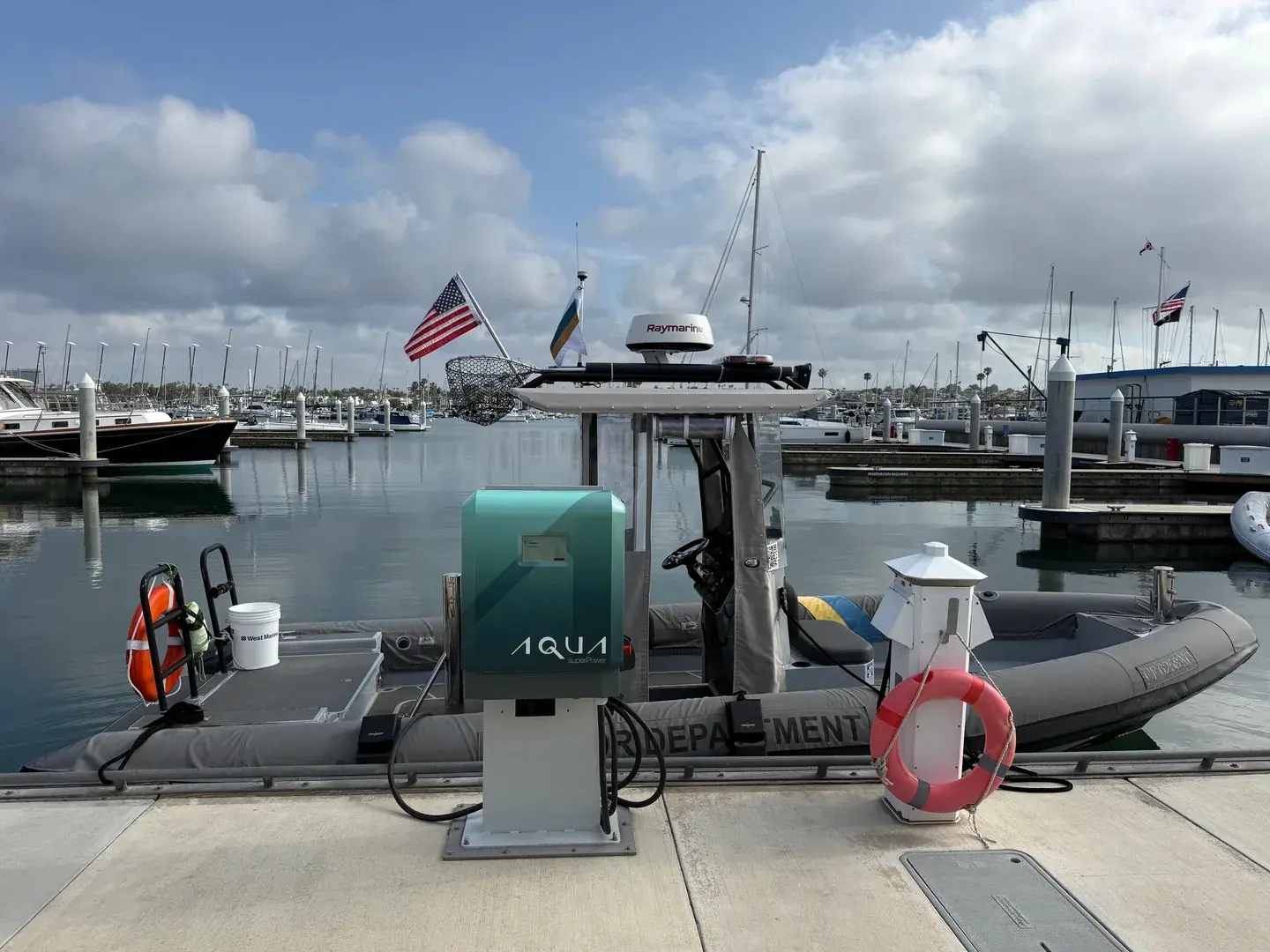
At Marina Park in Newport Beach, Aqua superPower has switched on Southern California’s first marine fast charger. Here is why it matters for electric boaters, what to verify before departure, and which limits still remain today.
Article outline
What happened
On May 6, 2026, Aqua superPower announced that Marina Park in Newport Beach had activated Southern California’s first marine fast charger on its network. According to the official release, the charger delivers up to 24 kW through the CCS standard and is designed for marine use, with access and payment handled through Aqua’s platform and app.
This matters because Newport Harbor is one of the busiest recreational harbors on the California coast. A dedicated charging point in a port with real boat traffic, tenders, electric dayboats, and service craft makes electric boating slightly less experimental and more practical to plan around.
Why this matters in practice
One of the biggest real limits for electric boating has not only been range on the boat itself, but uncertainty at the destination. Owners may accept a short run with a prudent reserve, but it is harder to build a full day or weekend around an itinerary if they do not know where they can recharge, which connector applies, or how reliable the stop will be.
The Newport Beach charger does not solve the West Coast charging gap on its own, but it adds three practical pieces:
- it creates a recognizable stop in a heavily used harbor;
- it uses the CCS standard, which is increasingly important in marine electrification projects;
- it fits into a wider network that Aqua describes as already spanning North America and Europe, which makes route planning easier for owners who think in terms of usable corridors rather than one-off installations.
For owners running an electric dayboat or a short-range support craft, that can mean a more workable operating window: less dependence on private overnight charging and more scope for a technical stop during the day.
What owners and skippers should verify before relying on it
The development is positive, but it should not be read as a blanket green light. Before treating Newport Beach as an operational stop, it is worth checking four points.
1. Actual boat compatibility
The charger uses CCS. That does not automatically mean full compatibility with every electric boat or plug-in hybrid on the market. Owners should verify with the builder or onboard systems integrator:
- supported inlet type;
- maximum charging power accepted by the boat;
- approved adapters, if any;
- app or account activation process.
2. The harbor use case
A marina fast charger is most useful when the stop lines up with real activity: boarding, lunch, guest transfers, shoreside errands, or service work. If your normal use case assumes a very quick turnaround, 24 kW may be helpful, but it is not equivalent to the refueling rhythm of a conventional fuel dock.
3. Operational access
Aqua describes the charger as available to network members and managed through its app. When Newport Beach presented the project in 2024, the city described it as public-facing infrastructure. In practical terms, owners should verify before departure:
- whether pre-registration is required;
- how payment works;
- whether a suitable berth or docking position is available for charging;
- local Marina Park operating rules and hours.
4. A real backup plan
One charger does not remove operational risk. As long as the network remains thin, electric coastal boating still requires a conservative margin for weather, real-world consumption, current, wind, and harbor traffic.
What it signals for the boating market
The most interesting signal here is not only technical. It is infrastructural. When a relevant recreational harbor installs dedicated charging, it sends a message to three groups:
- builders, who gain a more credible use case for electric models;
- marinas, which get a concrete example of a service worth offering before demand becomes mainstream;
- owners, who can start evaluating electric propulsion not just as a demonstration, but as a useful solution for specific missions.
Newport Beach is also symbolic because the harbor had already taken a step toward electric propulsion with a Vita workboat for the harbor department. The charger therefore strengthens an existing direction: first the working vessel, then the infrastructure that makes the wider ecosystem more believable.
What to expect next
In the short term, this kind of installation matters most for local boating, harbor services, hospitality tenders, and carefully planned coastal runs. It does not yet change life for the average owner of a combustion-powered boat, and it does not by itself turn Southern California into a mature electric cruising network.
It does change one important thing, though: from this week onward, Newport Beach can be treated as a real point on the regional electric-boating map, not a theoretical one. For owners watching the next generation of zero-emission dayboats and chase boats, that is exactly the kind of signal worth tracking ahead of summer.
The Batoo view
Newport Beach’s new fast charger is not an overnight revolution, but it is the kind of infrastructure that moves the conversation from promise to real use. If you own a compatible electric boat, the right question is not only "how fast does it charge?" but "how much easier does it make a day on the water?"
Right now the answer is cautious but tangible: enough to improve trip planning, not enough to erase the limits. That is usually how serious marina transitions begin.
Sources and references
Sources consulted and references retained to verify data and context.
- Newport Beach Powers Up Sustainable Boating with Southern California’s First Aqua superPower Marine Fast ChargerAqua superPower · 2026-05-06
- The Week in Review — May 10, 2024City of Newport Beach · 2024-05-10
Continue reading

Chicago Grand Slam and the seven minutes that shape a match race
August 14, 2026 · 5 min read

Naples compresses the America’s Cup into eight AC40 races
August 11, 2026 · 5 min read

At the Copa del Rey, the multiplier outweighs the final beat
August 8, 2026 · 6 min read