U.S. boating market 2026: what to watch after the latest NMMA data before summer
NMMA's May 13, 2026 data shows a still-soft new-boat market. Here is what it really means for owners, buyers and sellers heading into the early-summer window.
Artikelübersicht
Why this matters now
On May 13, 2026, the National Marine Manufacturers Association released an update that deserves attention well beyond the trade press. The simple headline is that the U.S. new powerboat market remains under pressure just as many owners and buyers are entering the pre-summer decision window.
For Batoo readers, the value is not the headline alone but the practical effect. A soft market does not automatically mean easy bargains for everyone. It means different timing, more selective negotiations and a wider gap between the segments that are holding up and the ones that are clearly weaker.
What the latest NMMA data says
The broad picture
According to NMMA, on a rolling 12-month basis from March 2025 through February 2026, U.S. retail sales of new powerboats fell 8.8% year over year to 214,115 units.
NMMA also stresses that the available data only covers the first two months of 2026. That means it is not yet a verdict on the whole season, but it is a real signal about how the market entered spring.
The segments holding up better
Not every category is moving in the same direction. Freshwater fishing boats, which NMMA identifies as the largest segment by volume, were roughly flat year over year at 54,199 units and accounted for 34% of the retail sales covered by the report.
Outboard boats remain the largest block by volume at 67% of the total, but they were still down 6.9% on a rolling annual basis.
Where the pressure is sharper
Weakness is more visible in categories exposed to discretionary spending pressure. NMMA reports a 10.8% decline for personal watercraft and a 12.5% decline for pontoon boats.
That matters because when demand softens in the core U.S. market, the pace of promotions changes, negotiations become tougher and dealers often become more focused on converting leads into contracts.
Why the market remains cautious
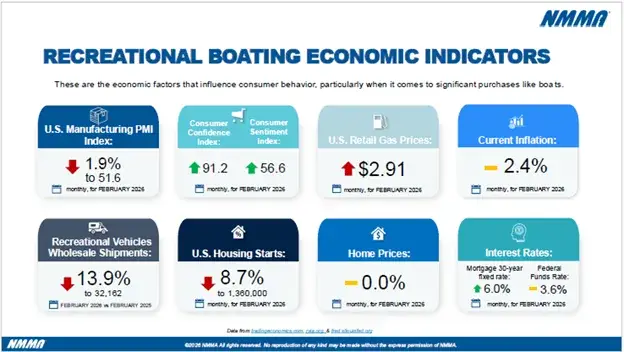
NMMA ties this phase to three clear factors: weak consumer confidence, subdued sentiment and still-elevated borrowing costs. In its May 13 release, the association cited consumer confidence at 91.2, sentiment at 56.6 and the 30-year fixed mortgage rate at 6.0%.
For boat buyers, those figures are not abstract macroeconomics. They translate into a basic ownership question: is the monthly payment, or the total cost of ownership more broadly, heavy enough to push households to delay, scale down or shift toward pre-owned boats, clubs and shared-access models?
This was already visible earlier in the year. In January 2026, NMMA described a relatively stable market that was still facing the same headwinds, with total new powerboat retail sales estimated to be down 8% to 10% in 2025. In that same update, it also noted that the pre-owned market represents about 80% of total annual unit sales, which is important when thinking about where demand may move if uncertainty lasts.
What it really means for owners, buyers and sellers
If you are buying
This is not automatically the moment of the biggest discount, but it is a moment when preparation matters.
- Ask about actual availability and delivery timing, not just sticker price.
- Check whether the dealer has room to move on accessories, commissioning, storage or after-sales support.
- Compare a new boat with a well-kept recent pre-owned option. In a slower market, perceived value can matter more than the headline discount.
- If you are shopping weaker segments such as pontoons or PWCs, pay close attention to inventory and dealer motivation.
If you are selling
Private sellers and dealers are not in the same position. In a slower market, poorly presented boats or listings priced off outdated comparables can sit longer.
- Put documented maintenance, clean presentation and strong photos in place before listing.
- Do not anchor to peak post-pandemic pricing if your local market is no longer supporting it.
- If your boat sits in a resilient or easily trailerable segment, listing quality may matter more than squeezing out the last bit of price.
If you already own the boat you plan to keep
Even without an immediate sale or purchase, a soft market is a useful reminder that your boat's value increasingly depends on maintenance history, reliability and predictable running costs.
In practical terms, that means going into the season with service work, electronics, safety gear and paperwork in order. In a selective market, boats that signal uncertain future costs become less liquid.
What to watch over the next few weeks
NMMA says the spring selling season will be the real test of 2026 demand. That is the key point to track between now and early summer.
Three signals worth watching
- Whether accessible, trailerable segments continue to show better resilience.
- How the pre-owned market behaves, since it remains a crucial release valve when new-boat demand slows.
- Whether financing conditions and consumer confidence improve enough to change the tempo of purchase decisions.
Batoo's view
The May 13, 2026 NMMA release does not describe a market collapse. It describes a sector entering the decisive part of the season with more cautious buyers and with segments moving at different speeds.
For Batoo readers, the practical conclusion is straightforward: generic sales messaging matters less in this environment, while case-by-case analysis matters more. Buyers need to look beyond the list price. Sellers need to be realistic. Owners who stay with their current boat need to protect value and reliability.
In a less impulsive market, preparation and timing become a real advantage again.
Quellen und Verweise
Konsultierte Quellen und erhaltene Verweise zur Prüfung von Daten und Kontext.
- Early 2026 Data Reflects Continued Market SoftnessNMMA · 2026-05-13T00:00:00Z
- Mixed Economic Conditions Shape a Stable Start To 2026 For U.S. Recreational Boating IndustryNMMA · 2026-01-08T00:00:00Z
- Navigating Headwinds and Positioning Recreational Boating for GrowthNMMA · 2026-04-24T00:00:00Z
Weiterlesen

Vessev VS–9 startet in den USA in die industrielle Bewährungsprobe
22. August 2026 · 4 Min. Lesezeit

194 Boote vor Hamilton Island zeigen einen robusten Segelmarkt
20. August 2026 · 5 Min. Lesezeit

Seafinn 80 Anya in der Auktion: Startgebot ohne Preisschild
18. August 2026 · 5 Min. Lesezeit