U.S. boat market, July 2026: what really changes now for buyers and sellers
NMMA’s July 10, 2026 update shows new powerboat retail unit sales down 7.1% on a rolling 12-month basis, while freshwater fishing boats remain slightly positive. Here is the practical guide to buying, selling, or waiting without misreading the market.
Article outline
The signal worth reading properly
On July 10, 2026, the National Marine Manufacturers Association published an update that matters well beyond the U.S. headline cycle. The key figure is clear: new powerboat retail unit sales were down 7.1% on a rolling 12-month basis for May 2025 through April 2026.
The same update also says two important things. First, the market is not weakening evenly. Second, new freshwater fishing boats still posted a slight 0.4% year-over-year retail gain.
For an owner or an active buyer, that matters more than the headline. This is not a frozen market. It is a more selective market, more sensitive to final transaction value, and more dependent on financing conditions.
What is behind the slowdown
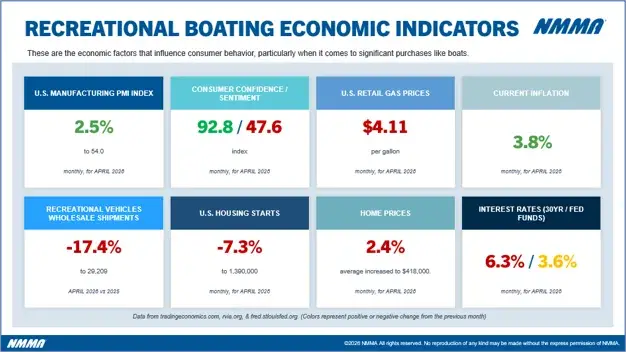
According to NMMA, the backdrop is still shaped by elevated interest rates and cautious consumer sentiment. The association also says inflation, high rates, and slowing housing starts continue to weigh on discretionary spending.
In practical terms:
- buyers are comparing total ownership cost more carefully
- financing has more influence on the final decision than it did before
- inventory that is not tightly aligned with demand may move more slowly
That does not mean every negotiation turns into a discount deal. It means the market is rewarding boats with a clear use case, the right specification, and immediate availability.
What changes if you want to buy now
1. You may have more room to negotiate, but not everywhere
A broad decline in units sold does not automatically create bargains in every segment. The positive freshwater fishing data suggests that categories with steadier demand can defend pricing and timing better than the average market.
If you are shopping for a boat with a clear purpose, the right setup, and active in-season demand, negotiate carefully but do not assume deep cuts will appear by default.
2. The real price is the financed price
With borrowing costs still elevated, the difference between an apparent deal and a smart purchase often comes from the cost of money. Before closing, it makes sense to check:
- the real monthly payment
- the financing term
- the impact of insurance, berthing, and routine maintenance
- the trade-in value inside the full package
In a more cautious market, many mistakes come from looking only at the list price.
3. Timing matters more than urgency
NMMA says the summer selling season should be watched through consumer confidence, financing conditions, and wider economic trends. For buyers, that means the next few weeks are a validation window, not an automatic signal.
If you find the right boat with a clear mission and sustainable numbers, waiting only to chase an extra discount may not be the best move. If you are still undecided between several models, or between new and pre-owned, a softer market can buy you useful time.
What changes if you want to sell
Preparation and pricing matter again
In a less impulsive phase, presentation, documented maintenance, and a realistic asking position make a bigger difference. The useful benchmark is not the number you hope for. It is the number that keeps the boat competitive against similar alternatives and a heavier financing burden for the buyer.
Trade-ins should be treated as a lever, not a detail
Because pre-owned boats still represent a large share of the total market, trade-ins can become decisive inside a negotiation. Do not look at the trade number in isolation. Compare it with the new-boat discount, delivery timing, and total financing cost.
The part many people misread
The 7.1% decline does not, by itself, describe a weak boating economy in absolute terms. On July 6, 2026, NMMA also said U.S. recreational marine retail spending reached $54 billion in 2025. The same update noted that pre-owned boats accounted for 79.7% of total boat unit sales in 2025.
The more useful reading is not alarmist. It is this: fewer new boats are being sold, but boating remains a large market where segment choice, timing, and deal structure matter more than before.
Batoo practical checklist
If you are buying
- compare total cost, not only the entry price
- separate the boat's real value from the financing cost
- check whether your target segment is holding up better or worse than the average
- do not delay a good deal only to chase a hypothetical extra discount
If you are selling
- organize documents, maintenance history, and onboard equipment clearly
- avoid asking prices anchored to last season rather than today’s market
- treat trade-in, delivery timing, and price as one package
- prioritize transparency and execution speed
Bottom line
NMMA’s July 10, 2026 update does not say the market should stop. It says the market should be read more carefully. For anyone buying or selling a boat right now, the difference will not come from the headline itself, but from the quality of the full economic decision.
Sources and references
Sources consulted and references retained to verify data and context.
- Latest NMMA Data Summary Provides Insight into Shifting Market ConditionsNational Marine Manufacturers Association · 2026-07-10T00:00:00Z
- U.S. Recreational Marine Spending Reached $54 Billion in 2025National Marine Manufacturers Association · 2026-07-06T00:00:00Z
Continue reading

Vessev VS–9 enters America and faces the industrial test
August 22, 2026 · 4 min read

Hamilton Island’s 194-boat fleet reveals a resilient sailing market
August 20, 2026 · 5 min read
Seafinn 80 Anya at auction, beyond the €200,000 opening bid
August 18, 2026 · 5 min read