Sunreef 100 Eco: what to really watch after the first launch
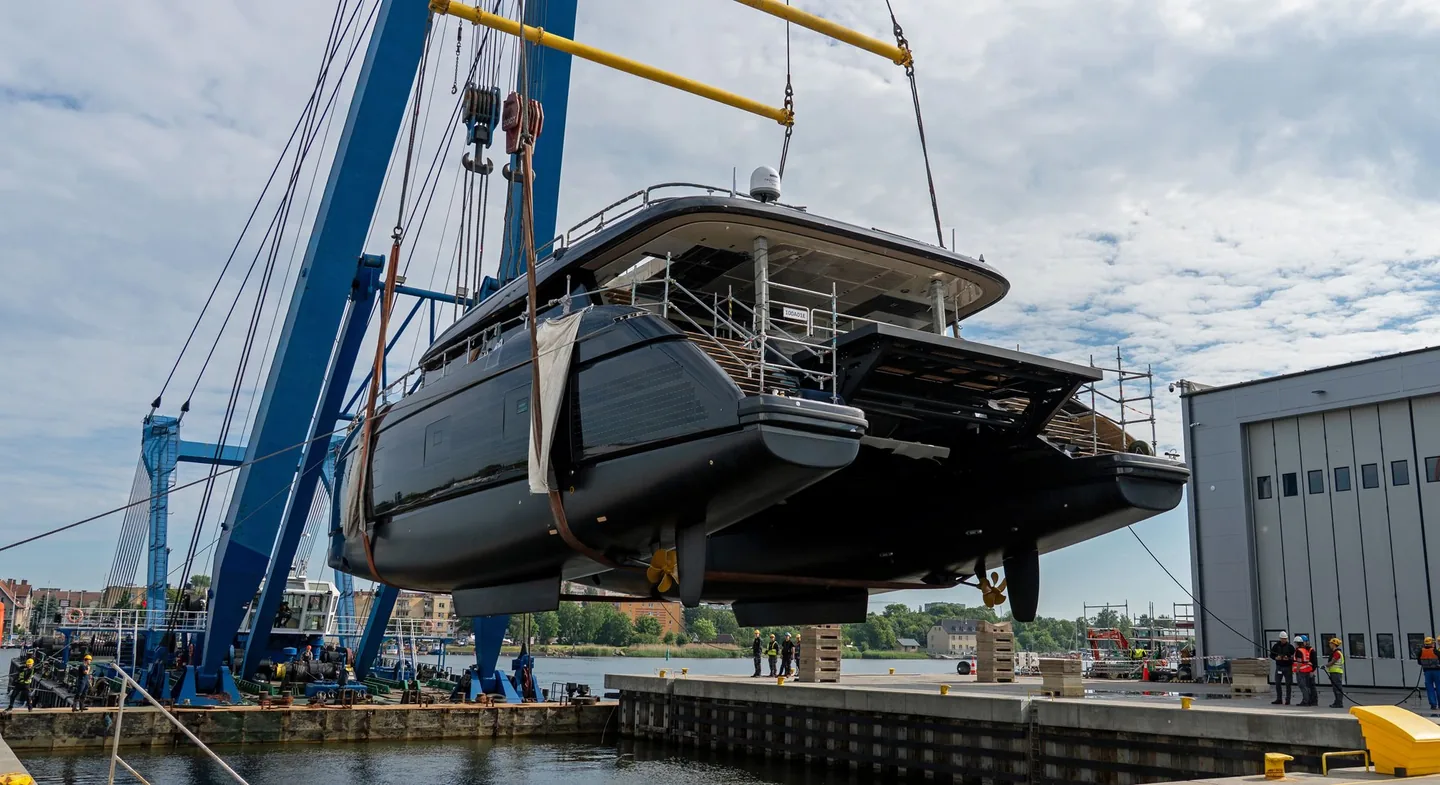
The first Sunreef 100 Eco was launched in Poland on June 17, 2026. Here is what really matters for owners and buyers: electric propulsion, solar integration, marina operations and the checks to make before calling it a benchmark.
Article outline
Why this launch matters
On June 17, 2026, Sunreef Yachts announced the launch of the first Sunreef 100 Eco at its Gdansk shipyard. For Batoo readers, this is not interesting only because of the yacht's size or the brand's premium positioning.
It matters because it puts into the water, in a cruising supercat format, a combination that many owners are watching closely: electric propulsion, a large battery bank, solar panels integrated into the structure, and an operating logic aimed at reducing diesel dependence during maneuvers and low-load use.
The facts confirmed now
The available sources support a few clear points:
- the first unit has been launched in Poland
- the yacht is now moving into final outfitting and sea trials
- its public debut is planned for the 2026 Monaco Yacht Show
- the model uses twin 360 kW electric engines and a 770 kWh battery bank
- the solar system is integrated into the hulls, superstructure and bimini
- the declared solar surface reaches 242.5 square meters
That is already enough for a practical first reading: the Sunreef 100 Eco is not a trade-show concept. It is a real product that now has to prove whether a large-format yacht can use electric architecture credibly in daily onboard operations.
What owners and buyers should actually watch
1. Real marina use
The most interesting promise is not absolute zero-emission passagemaking. It is the possibility of entering and leaving marinas, moving at low speed, managing time at anchor and supporting onboard loads with less noise, less vibration and less immediate dependence on conventional generators.
For an owner, that means checking three very concrete points:
- how long the yacht can operate quietly during maneuvers and short transfers
- how much hotel load is created by air conditioning, galley use, tender support and guest services
- in which scenarios the system still requires conservative energy planning
2. Solar integration as support, not slogan
The integration of solar panels into the structure is probably the project's strongest technical message. But the point is not simply to have visible panels or a headline number.
The real question is how much this distributed generation improves the yacht's energy profile during a normal day at anchor, under sail and inside a marina. That is why the important test will not be the brochure. It will be performance in sea trials and then in real seasonal use.
3. The catamaran platform advantage
On a 100-foot catamaran, volume and beam help. There is more useful surface for photovoltaic integration, more room for batteries and technical systems, and a layout that can make a complex energy package workable without sacrificing too much onboard living space.
That is why the Sunreef 100 Eco should be read not only as a new model, but as an indicator of where the large luxury catamaran segment expects to go over the next few years.
Where caution is still needed
The mistake would be to treat this launch as definitive proof that the energy problem of large-scale cruising has been solved. It has not.
Before calling it a benchmark, a serious buyer should wait for verifiable data on:
- autonomy profiles in different operating conditions
- effective charging times and charging logic
- the real contribution of regeneration and solar power to the energy balance
- the effect of system weight on performance, maintenance and lifecycle
- the service network and technical expertise available for high-complexity systems
In other words, the project looks credible, but real validation starts only when the shipyard, the owner and the market begin measuring it outside launch-day messaging.
What it means for Batoo readers
Even readers who are not shopping for a 100-foot supercat can take something useful from this launch. Innovations that first appear on very large platforms often preview solutions that later move downmarket.
Three signals are worth following:
- electric propulsion is moving from experiment to product architecture in parts of the premium market
- integrated solar is becoming part of industrial design, not an add-on
- the market conversation is shifting from speed alone to the quality of operations at anchor and in port
The Batoo view
The Sunreef 100 Eco deserves attention because it moves the discussion away from generic eco-marketing and toward a more practical question: how much of real life on board can be covered more quietly, more cleanly and with better energy control?
If sea trials confirm consistency between layout, battery bank, electric propulsion and solar generation, the first 100 Eco could become one of the most closely watched cases of 2026 in the large luxury catamaran segment.
For now, the correct reading is simple: a highly relevant launch, a serious technology promise, and a final verdict that still depends on real-world operation and operating data.
Sources and references
Sources consulted and references retained to verify data and context.
- Sunreef 100 Eco Yacht Shows Off Solar SkinMegayacht News · 2026-06-17
- Sunreef splashes first 100 EcoYacht Style · 2026-06-18
- Sunreef 100 Eco: The Sustainable SupercatSunreef Yachts