Azimut Seadeck 9 puts silent anchoring ahead of hybrid promise
Seadeck 9 already offers a 60 kWh Hotel Mode while its propulsion is prepared for hybrid integration. That distinction defines this 26-metre flagship.

Article outline
Azimut Seadeck 9 reaches its Cannes public debut with a proposition more useful than a broad hybrid label: it can shut down its generators while the yacht is at rest. On a 26-metre boat, hotel loads and noise at anchor shape daily life as much as propulsion does. Its 60 kWh Hotel Mode is already specified; the triple Volvo Penta IPS installation is described as compatible with future hybrid-electric integration. That distinction is where a serious appraisal should begin.
Sixty kilowatt-hours improve the anchorage, not the passage
Azimut claims up to four hours of daytime autonomy and eight hours at night with the generators off. Stabilizers, air conditioning, 220-volt sockets, entertainment systems and occasional galley use remain available. The pack is said to recharge in five hours from shore power or four hours from a generator, with more than 3,500 cycles and a service life of up to ten years. These are builder figures, not a guarantee for every cruising pattern, but they describe a defined and testable function.
The operative phrase in Azimut Seadeck 9 Hotel Mode is hotel load. The battery is not presented as propulsion energy for silent passages. Its task is to remove vibration, exhaust smell and machinery noise during dinner, sleep or swimming. That may be less theatrical than electric cruising, yet it will be used far more often by many Mediterranean owners.
A buyer should move beyond the headline endurance. The yard or dealer needs to model the energy budget against outside temperature, air-conditioning set point, active stabilizers, galley demand and guest count. Usable rather than nominal capacity matters. So do load-shedding behaviour, battery-health reporting and performance after several seasons. TheAzimut listings and brand pagecan support wider research, but the brochure must ultimately give way to a technical demonstration aboard the actual yacht.
Hybrid-ready is not the same as hybrid delivered
Seadeck 9 uses three Volvo Penta IPS units and a structure designed to accept hybrid-electric technology. Azimut’s January announcement carefully says the yacht is prepared for installation of the system. It does not say the yacht being shown can already cruise under electric power. This wording matters because an upgrade path is not an installed, commissioned and warranted propulsion package.
Before attaching resale value to that readiness, buyers need written answers. Which components, cables and control interfaces are already aboard? What volume and weight have been reserved? Does the upgrade have a launch date, fixed price and defined warranty? Will ventilation, cooling, software or certification work be required? Most importantly, what speed and endurance would electric operation provide? Until those points are contracted, readiness creates optionality rather than measurable operating savings.
Comparison is still worthwhile. BrowsingFerretti YachtsandAbsolutecan widen a search for Italian alternatives, but range, displacement and equipment should be compared yacht by yacht. A shared national design culture does not make the engineering equivalent.
Efficiency begins upstream of the powertrain
Azimut says Seadeck 9 can reduce fuel use and emissions by as much as 30 percent over an average year compared with similarly sized yachts using conventional hulls and shaft drives. The claim combines a planing hull developed with Names, carbon fibre in 40 percent of the structure and the IPS installation. The builder says the hull planes early and enlarges the band of speeds at which efficiency is strongest.
Thirty percent is not a universal result. It depends on the reference boat and the assumed annual duty cycle. The more durable point is architectural: lower mass and resistance deliver benefits on every mile, whether or not a hybrid module arrives later. A meaningful sea trial should record litres per nautical mile over several speeds, along with test displacement, sea state and hotel loads. Maximum speed alone would reveal little about the design’s central claim.
There is a cost to technical density. Carbon construction, three pods and a sizeable lithium hotel system demand good access, trained service support and clear isolation procedures. Replacement cost and battery logistics belong in the ownership budget. Within the wider Azimut|Benetti group, theBenetti brand pageoffers useful portfolio context, but it should not suggest that the two yards use an identical technical platform.
The open stern must work after the photographs
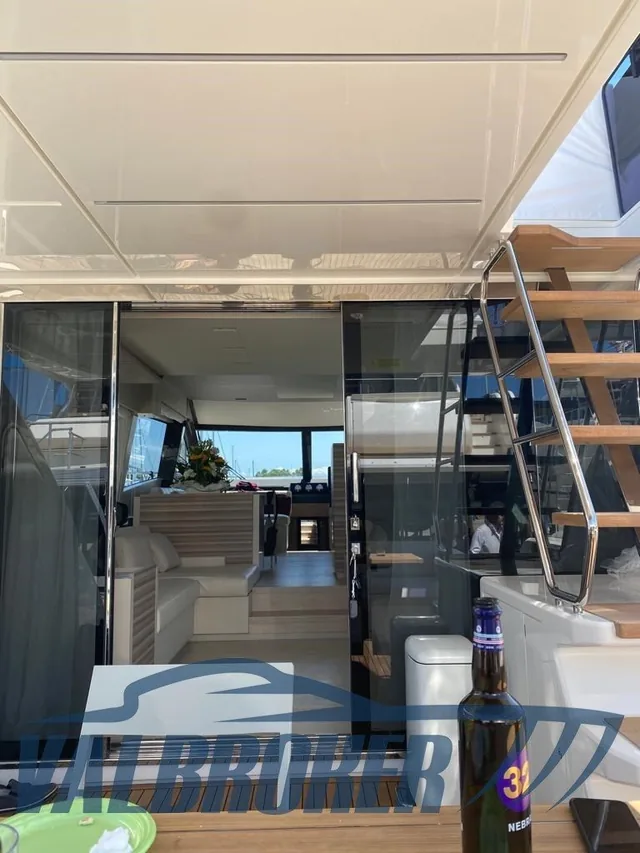
The defining space is a 60-square-metre Fun Island with three descending terraces, a flush pool, opening side wings and a seven-square-metre transformer platform. A disappearing glass door continues the main saloon aft. Below, the arrangement includes an owner’s cabin, a VIP and two guest cabins, while separate crew circulation is intended to preserve privacy. The social centre is deliberately placed near the water, making silent hotel operation feel integral rather than added later.
This much openness calls for seamanship questions. Buyers should watch the closing sequence, drainage and furniture securing, and examine child protection, operation in a swell and access to the platform. The pool adds questions about water management, weight and maintenance. The real quality measure will be how quickly the crew can change from anchorage mode to a safe seagoing configuration without turning every departure into a project.
Seadeck 9 is most persuasive when treated as an integrated yacht rather than an environmental manifesto. It already presents one outcome that can be tested: several quiet hours with meaningful services running. Its hull, weight reduction and pod drives also pursue efficiency without waiting for hybrid propulsion. Electrified cruising remains an option to specify and contract, not a capability to assume. The priorities are sound: improve the hours owners genuinely spend aboard, then require future technology to prove everything else.
Sources and references
Sources consulted and references retained to verify data and context.
- Seadeck 9, The Time We Choose to LiveAzimut Yachts · 2026-07-16
- Seadeck 9: battesimo sotto le montagneAzimut Yachts · 2026-01-30
- Matteo Thun and Antonio Rodriguez shape Azimut’s new flagship yacht, Seadeck 9Wallpaper* · 2026-08-04