U.S. boating market in June 2026: new boats slow, used boats stay strong
Fresh NMMA data shows a weaker first quarter for new boats and a very large used-boat market. Here is what that really means for buyers and sellers in summer 2026.
Article outline
Why this update matters
Within 72 hours, the National Marine Manufacturers Association released two data points that make more sense when read together. One covers the U.S. new-boat market. The other shows the real weight of the used-boat market.
Taken separately, they look like routine statistics. Taken together, they offer a more practical message for anyone planning to buy, sell, or reposition a boat in summer 2026.
The figures that actually change the picture
According to NMMA, U.S. new powerboat retail sales fell 5.6% in the early months of 2026, reaching 38,052 units compared with the same period of 2025.
In the same update, the association said the most resilient segments were freshwater fishing boats, down 1.3%, and personal watercraft, down 1.0%.
Outboard boats still represent the largest share of the new-boat market by propulsion type, with 24,596 units sold year to date, but that category was also down 6.6% from 2025.
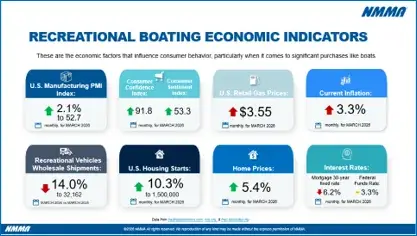
On the macro side, the same source listed consumer confidence at 91.8, consumer sentiment at 53.3, the 30-year fixed mortgage rate at 6.2%, and inflation at 3.3% in March.
Two days later, NMMA underlined how large the parallel used market remains: in 2025, pre-owned boat sales in the United States totaled 867,059 units with a market value of $10.8 billion.
Used outboard boats led that market by unit volume, while personal watercraft and sterndrive boats remained among the highest-volume segments. NMMA also highlighted continued demand for mid-sized vessels.
What it means for buyers
The first takeaway is straightforward: anyone shopping today is not entering a uniform market.
On the new side, weaker first-quarter sales point to a more selective environment than the recent years of compressed supply and tighter pricing. That is a reasonable inference from the NMMA data, not a guarantee, but it may translate into more room to negotiate equipment, delivery timing, warranty coverage, or included accessories rather than focusing only on sticker price.
On the used side, the total market size sends a different message: supply is still deep enough that buyers do not need to rush simply out of fear that no alternatives will appear.
Three practical moves before signing
- Compare a new boat and a used boat on first-year total ownership cost, not just entry price.
- Ask for maintenance history, engine records, and the condition of electronics, trailer, and onboard systems before the final payment discussion.
- Check whether your target segment is one of the more resilient ones or one of the more crowded ones, because that affects realistic negotiating leverage.
What it means for sellers
For sellers, the message is less comfortable but useful. A slower new-boat market does not automatically freeze the used market, but it does make buyers more comparative.
In practice, a used boat offered without documented maintenance, weak photography, or pricing built on memories of 2021 or 2022 can lose attention faster.
By contrast, boats presented clearly, with transparent refit work and coherent equipment lists, can still stand out in a market that NMMA describes as enormous in both volume and value.
The minimum checklist to sell better
- Prepare proof of recent maintenance and any major work already completed.
- State engine details, hours, electronics, and the main costs likely to arise in the next 12 months.
- Position the asking price against real alternatives in the same segment, not against personal expectations.
The Batoo takeaway
For a European or Mediterranean owner, these are still U.S. numbers, but the signal is useful well beyond the American market: when borrowing costs stay elevated and confidence stays fragile, the market stops rewarding new boats automatically and puts more value on transparency.
That is why the right question in June 2026 is not only which boat to buy. It is which purchase carries the most controllable risk across upfront spend, expected maintenance, and future resale.
What to watch in the coming weeks
If you are buying
- Real in-stock availability.
- Financing terms proposed by the dealer or broker.
- Quality and completeness of the technical documentation.
If you are selling
- Response time to listings.
- How early buyers start negotiating before a visit.
- Whether the boat stands out on condition instead of marketing language.
The most important data point today is not that the market is collapsing. It is that the market is becoming more selective again. For disciplined buyers and sellers, that matters.
Sources and references
Sources consulted and references retained to verify data and context.
- Latest NMMA Report Shows Continued Softness in Powerboat Market Through MarchNational Marine Manufacturers Association · 2026-06-15T00:00:00Z
- New NMMA Report Provides Insight Into 2025 Pre-Owned Boat MarketNational Marine Manufacturers Association · 2026-06-17T00:00:00Z
Continue reading

Vessev VS–9 enters America and faces the industrial test
August 22, 2026 · 4 min read

Hamilton Island’s 194-boat fleet reveals a resilient sailing market
August 20, 2026 · 5 min read

Seafinn 80 Anya at auction, beyond the €200,000 opening bid
August 18, 2026 · 5 min read