Lake Tahoe crowns Riva as provenance takes centre stage
Lake Tahoe Concours d’Elegance has made Riva its 2026 marque class. A buyer brief on documentation, originality and restoration in the classic runabout market.
Article outline
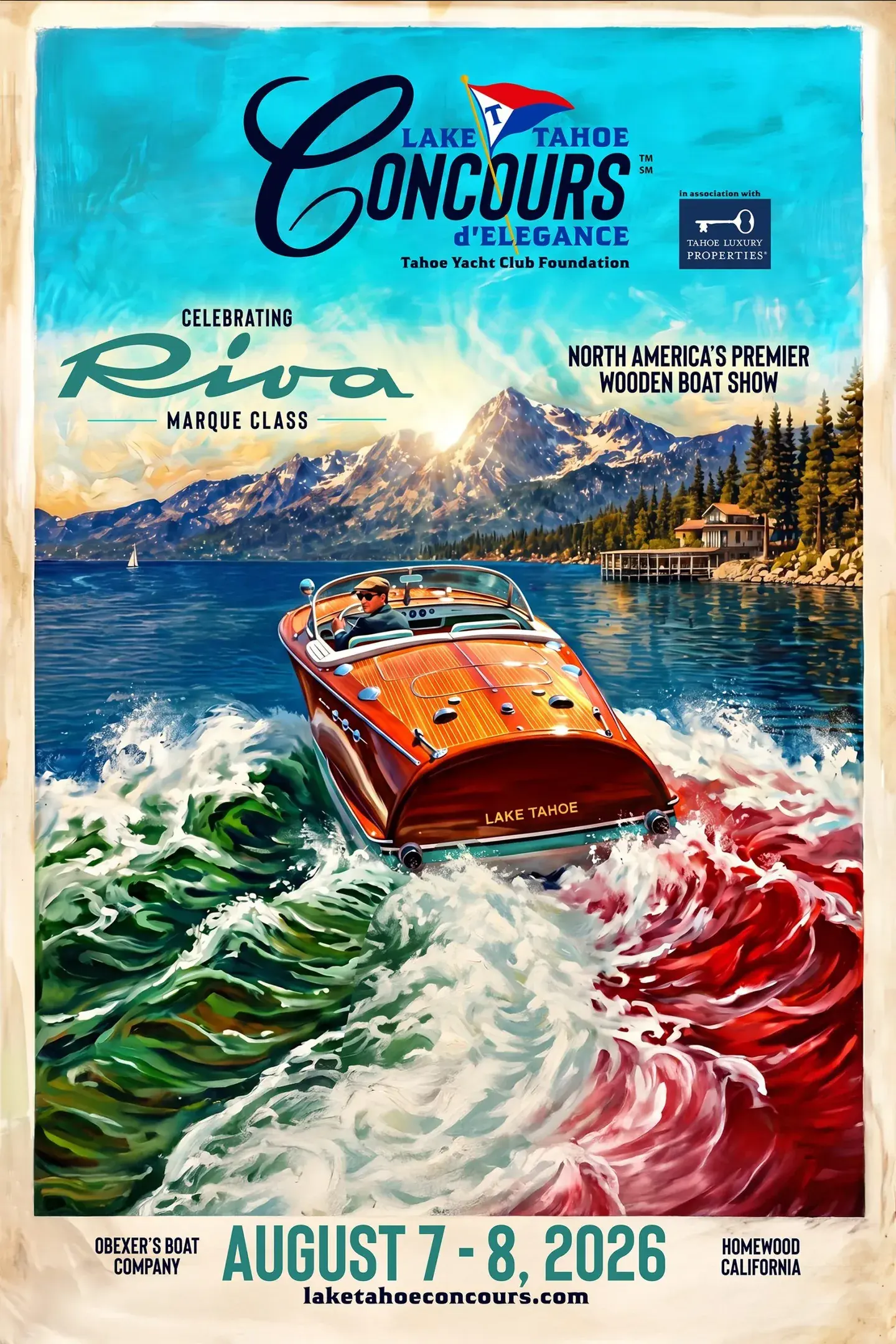
Lake Tahoe Concours d’Elegance chose Riva as the marque class for its 52nd edition, held on 7–8 August 2026. The Californian gathering was more than a mahogany parade: it showed how a boat’s verifiable history is becoming part of the asset itself in the collector market.
For an owner or buyer considering classic Riva boats, the interesting question is not whether the Aquarama is an icon. That status is established. The useful question is why two examples of the same model and period may represent very different propositions. The Concours supplied an indirect answer: applicants had to submit current photographs, a concise boat history, distinguishing characteristics and any awards, while acceptance remained subject to committee approval.
Selection begins with the story, not the shine
The organiser describes Lake Tahoe as a leading showcase for preserved and restored wooden boats and says the lake has the largest concentration of Rivas outside Europe. That is the organiser’s claim rather than an independently audited statistic, but it explains why this marque class carries weight. Scarcity is not discussed in the abstract here; comparable boats are assembled, viewed and run on the same water.
The entry process is equally instructive. Alongside high-resolution images, owners were asked for the history of the boat, unique details and awards. The Concours says visitors want to understand the stories behind the exhibits. In market language, that curiosity amounts to a demand for traceability.
Flawless varnish wins attention, but it cannot by itself establish the chain of ownership, work completed, components changed or years spent in storage. A coherent file narrows uncertainty and gives a surveyor and buyer better questions to ask. Anyone reviewing opportunities with a specialist such asColumbus Yachtingshould therefore treat the archive as part of the inspection, not as decorative paperwork.
Aquarama sets the reference without defining the whole field
Riva dates the Aquarama’s creation to 1962. The yard also records that wooden runabout production continued until 1996, when the final Aquarama Special, number 784, was built. Those dates are confirmed by the manufacturer and prevent an overly narrow view: collectible Rivas span different eras, models and configurations rather than a single celebrated profile.
The move into fibreglass began in 1969 with the Bahia Mar 20’ and Sport Fisherman 25’, while wooden construction continued in parallel. That overlap matters. Age and material do not confer prestige automatically, and an early composite boat can have a documentary significance quite different from a mahogany runabout. Batoo’sRiva shipyard pagehelps place present-day listings within the marque’s continuity without confusing heritage craft with the current range.
Our market reading is straightforward: the badge generates demand, but the identity of the individual boat determines how readily demand becomes confidence. Hull number, agreement between papers and physical evidence, the chronology of work and transparent modifications carry more weight than an attractive story that cannot be demonstrated. This is an analytical framework, not a universal price formula.
A credible restoration allows the past to remain visible
Riva states that Carlo Riva founded RAM — Revisione Assistenza Motoscafi — beside the Sarnico yard in 1957. According to the brand, RAM Riva Classiche now maintains and restores mahogany and fibreglass Rivas from 6 to 13 metres using original techniques, materials and know-how. Riva also describes a 24-stage hand-varnishing process for wooden parts.
These facts do not mean that only factory-supported work has merit. They do provide a benchmark: restoration should be assessed through method, evidence and respect for configuration, not only the gloss visible at handover. Itemised invoices, photographs during disassembly, the provenance of replacement parts and reasons for substitutions help separate preservation, restoration and reinterpretation.
When widening a search throughMarina Yacht Sales, the sharper question is not simply “how much was spent?” It is “what survived, what was remade, and what proves it?” Expensive work may correct serious faults, yet it may also remove historical substance if decisions are inconsistent or poorly recorded.
Fresh water is context, not a condition report
Tahoe introduces a detail that sales copy often simplifies: operating biography. A boat used mainly in fresh water is not automatically superior to one run at sea. Storage conditions, ventilation, duty cycles, maintenance of machinery and the standard of previous work are more revealing than the geographic label alone.
A buyer should connect the visual review with an independent inspection appropriate to hull, engines and systems. Timber construction requires particular expertise; early fibreglass models create a different set of questions. The purpose is not to impose a generic checklist, but to build an investigation around the individual boat. Listings accessible throughValbrokercan help compare descriptions, equipment and positioning, but they cannot replace a survey or primary records.
The same discipline applies when considering newer yachts within the wider industrial group. BrowsingFerretti Yachtscan supply contemporary market context, but it proves no connection to the boats displayed at Tahoe. The Concours and these internal pages play separate roles: one describes its curated show; the others broaden market research.
The rarest quality is a boat that can be understood
Lake Tahoe celebrated Italian style, speed and craftsmanship. Its most practical message for a buyer is less photogenic: a historic Riva becomes easier to assess when every major transition leaves a coherent record. Complete provenance does not remove technical risk, and an award is not a survey, but both can direct scrutiny towards the right places.
Collector value therefore rests on the intersection of three qualities: certain identity, material preserved or restored with judgement, and the ability to keep using the boat without erasing its character. Mahogany draws a crowd to the dock. Once the dock is behind you, documentation and the actual standard of workmanship are what support a decision.
Sources and references
Sources consulted and references retained to verify data and context.
- Lake Tahoe Concours d’Elegance 2026Tahoe Yacht Club Foundation
- Show Your Boat — 2026 Marque Class: RivaTahoe Yacht Club Foundation
- Riva HistoryRiva
Continue reading

Vessev VS–9 enters America and faces the industrial test
August 22, 2026 · 4 min read

Hamilton Island’s 194-boat fleet reveals a resilient sailing market
August 20, 2026 · 5 min read

Seafinn 80 Anya at auction, beyond the €200,000 opening bid
August 18, 2026 · 5 min read