Boat fire extinguishers: inspect, place and replace
A practical routine for reading the label, checking pressure, pin, nozzle and corrosion, choosing an accessible position, and deciding when service or replacement is due.
In brief
Inspect a portable boat extinguisher in its normal location: it should be immediately accessible, suitable for the vessel, with its indicator in the operating range, pin and seal intact, nozzle clear, and cylinder free of serious corrosion or damage. After any use, failed check, or manufacturer-defined limit, replace a disposable unit or have a rechargeable one serviced by a qualified technician.
Article outline
A fire extinguisher can satisfy a paperwork check yet fail the crew in practice. It may be buried behind cruising gear, held by an awkward bracket, fitted with a blocked nozzle, or unsuitable for the rule that applies to the vessel. A useful inspection therefore tests the appliance, its location, and the human action needed to reach it.
This guide sets out an owner-level routine for portable extinguishers. Flag-state, local, class, vessel-type, and length requirements differ; the United States rules below are a worked example of regulatory reading, not a worldwide compliance table.
Identify the unit before judging its condition
Record the manufacturer, model, approval markings, fire rating, operating instructions, manufacturing date, and whether the unit is disposable or rechargeable. Photograph the complete label and keep the model in the vessel’s equipment log. A generic entry such as “one red extinguisher” cannot support a recall check or a model-specific service decision.
Match the marked rating to both the hazards aboard and the governing rule. Under the current US federal rule for many recreational vessels not over 65 feet, required portable capacity is expressed through 5-B and 20-B ratings; one 20-B unit may substitute for two 5-B units. That relationship belongs to the cited US framework and should not be imported into another jurisdiction without verification.
Also establish whether the machinery space has an approved fixed system. The US table reduces the stated portable minimum in some length bands when such a system is fitted. It does not prove that every practical access point is covered, and a vessel under another flag needs its own authoritative requirements.
Inspect the extinguisher where it actually lives
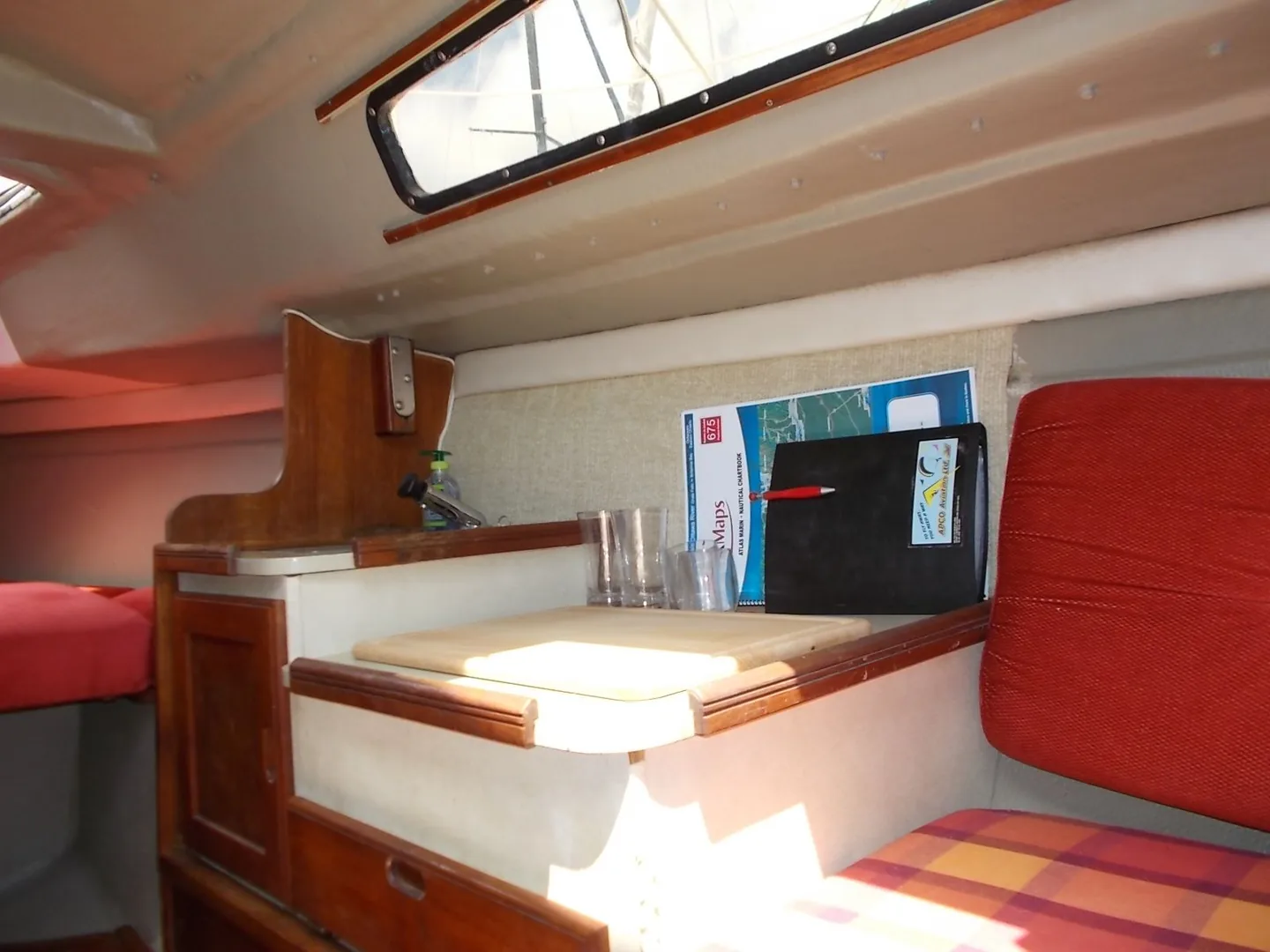
Begin with presence and access. The extinguisher should be visible or unmistakably marked, reachable without unloading a locker, and secured against vessel movement. An inspection performed on a workbench misses the obstruction that may matter most in an emergency.
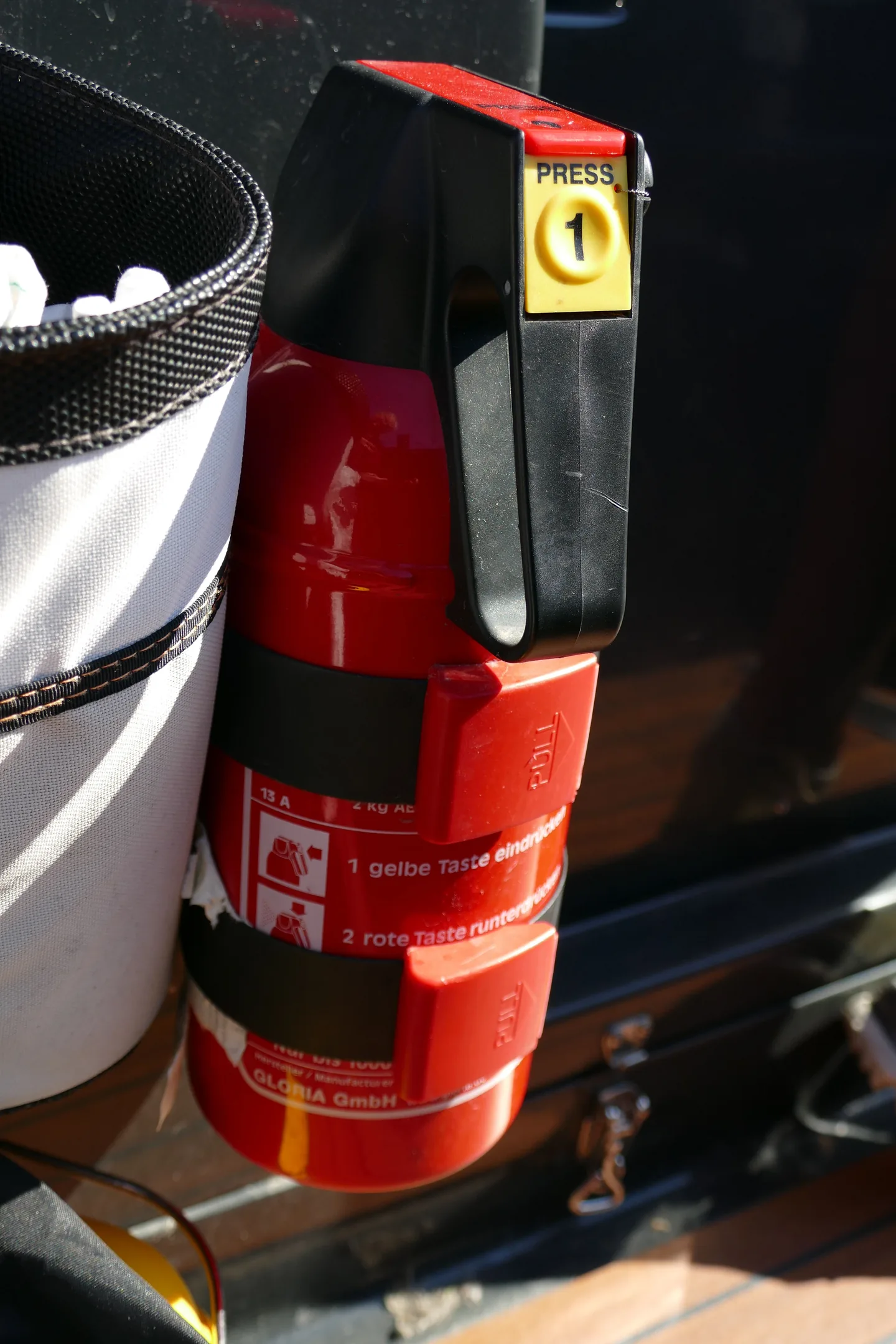
The US Coast Guard’s serviceability test provides a concise physical sequence: an indicator, when fitted, must sit in its operating range; the locking pin must be firmly in place; the nozzle must be clear; and the cylinder must show no significant corrosion or damage. Its FAQ also says the unit must be aboard, readily accessible, approved for the relevant requirement, unexpired, and not apparently used.
Check the bracket, retaining strap, hose or nozzle, label, safety seal, and tamper indicator. Kidde recommends a monthly visual inspection for leaks, dents, or corrosion and a check that the pressure-gauge indicator remains in the green zone. Follow the actual label and manufacturer’s manual where their instructions or interval differ.
Do not discharge a unit merely to see whether it works. An extinguisher that has been used or appears used has failed the ready-for-service check. A gauge outside its operating zone is likewise a decision point, not a cosmetic note.
Plan the mounting point from the escape route
The most useful extinguisher is one a person can collect while retaining a safe way out. This is Batoo operational analysis: mounting every unit beside the likely ignition source can force a crew member toward heat or smoke before gaining any firefighting capability. Galley, accommodation, cockpit, and machinery-space access deserve a route-based review.
Rehearse retrieval without operating the extinguisher. Open the door or locker, release the bracket, and let different crew members test whether the height and mechanism are manageable. Repeat the exercise with the boat packed as it normally sails, because soft bags, cushions, and seasonal gear can turn an apparently good location into a blocked one.
No single distance or locker layout makes every installation sound. Immediate access, a secure compatible bracket, legible instructions, and a route that does not trap the user are the core tests. Clear marking and a departure briefing make the physical installation intelligible to guests as well as regular crew.
Separate replacement from professional service
Disposable and rechargeable appliances do not follow the same failed-check path. The Coast Guard FAQ says a disposable extinguisher whose gauge is in the red must be discarded and replaced, while a rechargeable unit must be serviced and tagged. After any discharge, return-to-bracket is not an acceptable remedy.
For disposable UL-marked extinguishers within the US federal regime, the Coast Guard treats a unit as expired more than 12 years after its stamped manufacturing date. This is explicitly a US requirement, not a universal life limit. Elsewhere, use the manufacturer’s label and manual together with flag and local rules.
Rechargeable does not mean indefinitely serviceable without intervention. The unit follows its specified maintenance programme and qualified servicing. Kidde directs owners to the appropriate service route for rechargeable units; an owner inspection should not drift into dismantling, improvised repair, or recharge.
Corrosion, dents, leakage, a broken seal, obstructed nozzle, abnormal indicator, missing pin, illegible instructions, or evidence of discharge all justify taking the appliance out of the ready set until resolved. If the correct action is unclear, identify the exact model and ask an authorised service provider rather than guessing from another extinguisher’s instructions.
Fight only a small fire with a protected exit
Crew should learn the instructions before smoke makes the label difficult to read. Kidde presents the familiar PASS sequence: pull the pin, aim low at the base, squeeze the lever slowly and evenly, and sweep from side to side while keeping the agent directed at the base. Model-specific instructions remain decisive because controls and agents vary.
A portable extinguisher is for a small, containable fire, not a promise of control. Kidde places escape first and limits extinguisher use to a small fire; aboard a boat, growing heat, smoke, poor visibility, an uncertain agent, or loss of a safe exit should end the attempt. Raise the alarm, move people away, and follow the vessel’s emergency plan.
Before departure, assign simple roles for alarm, communications, passenger control, and safe shutdown of energy sources where practicable. This is a Batoo planning recommendation rather than a regulatory formula. Its purpose is to stop several people converging on one appliance while nobody accounts for the crew.
Turn the inspection into a short record
Give each extinguisher a location name and log its identity, type, marked date, indicator, pin, seal, nozzle, cylinder, bracket, and access result. Add the inspection date, the inspector, and any action opened. A label photograph helps preserve information, but it cannot demonstrate today’s pressure indication or physical condition.
Kidde recommends a monthly visual inspection while directing owners to the product label or manual for the applicable schedule. That general interval should not override model-specific instructions. Batoo also recommends a rapid accessibility check before a passage and after maintenance, impact, damp exposure, or major locker rearrangement.
Finish with a strict go/no-go question: is each required appliance identified, compliant with the rule that actually applies, immediately reachable, physically sound, and within the correct service path? An unknown answer is not a pass. The discipline is modest, but it turns a rarely noticed cylinder into an emergency tool the crew can genuinely find and use.
Sources and references
Sources consulted and references retained to verify data and context.
- 33 CFR § 175.320 — Fire extinguishing equipment requiredElectronic Code of Federal Regulations
- Fire Extinguishers Requirements for the Recreational Boater FAQU.S. Coast Guard Boating Safety Division
- Fire Extinguisher Inspections and ServiceKidde
- Tips on How to Use a Fire ExtinguisherKidde