Buster XL CC trades the lounge for a working deck
The new 6.05-metre Finnish centre console favours payload, clear walkways and modular shelter. A buyer brief after its Helsinki in-water debut.
Article outline
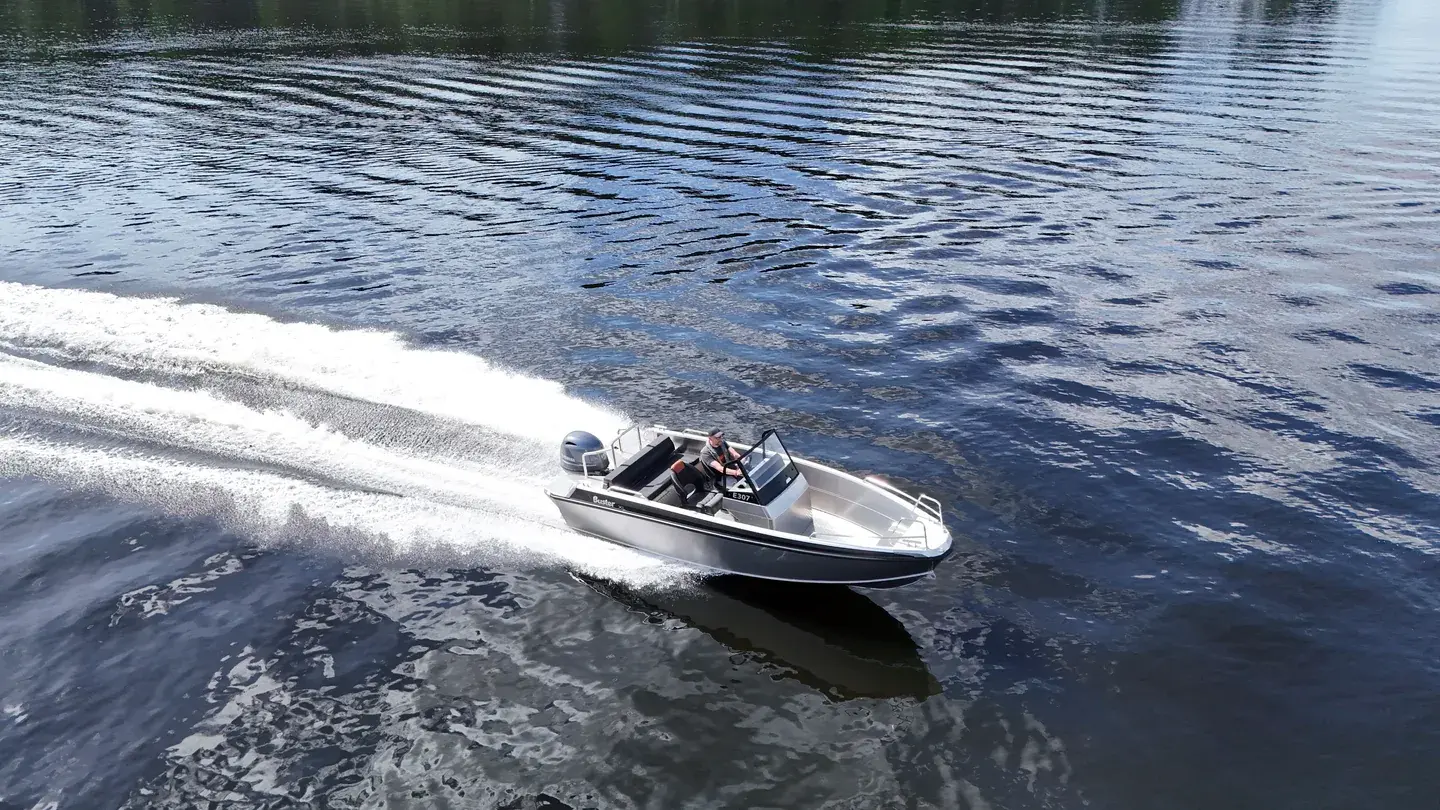
The Buster XL CC 2026 met the public afloat in Helsinki with a clear decision already made: on a 6.05-metre boat, the most valuable space is reserved for movement and payload rather than a lounge. That narrows its natural audience, but it also makes this new centre console unusually easy to understand for anyone who treats a boat as transport, a fishing platform or a working tool.
Shown publicly for the first time at Uiva Flytande, which closed on 16 August, the XL CC is 2.20 metres wide, weighs 740kg without an engine and takes outboards from 80 to 115hp. Buster rates it for six people and a 700kg payload. The revealing figure is therefore not the claimed top speed of roughly 36 knots; it is the near one-to-one relationship between empty weight and permitted load.
The centre console organises the deck rather than decorating it
The all-aluminium console leaves a passage on either side and a broad, flat area forward. Buster says two anglers can cast there side by side, or the space can take equipment and cargo. A wide aft bench and two separate offshore seats serve the passengers and helm, while a bench-storage box ahead of the console is optional.
This geometry deserves a practical reading. Symmetrical side decks simplify short-handed berthing, stepping onto a high quay and moving boxes or fenders fore and aft. The console also consumes width at the point of passage, however, and cannot provide the continuous shelter of a dual-console windscreen. Buyers comparing more furnished family craft can browseJeanneau's day-cruising rangeas a useful expression of the alternative; the yard has no stated connection with this launch.
The XL CC consequently favours a deck that can change jobs over a seating plan fixed by the builder. That is valuable when a boat moves between fishing, commuting and carrying supplies. It is less persuasive when the principal mission is entertaining six guests: certification for one person does not automatically create one comfortable, weather-protected seat.
A 700kg payload matters more than the six-person badge
The declared 700kg payload needs to be treated carefully. It includes people and equipment under the craft's certification conditions; it is not permission to load without calculation. Six adults, fuel, ground tackle, safety equipment and fishing kit can erode the margin quickly. The owner's manual, CE plate and sound weight distribution remain the operational references.
Even so, the number confirms the boat's purpose. A flat bow keeps the forward volume usable for awkward loads, while the large, level bathing platforms described by Buster should make boarding from the water or quay easier and create working room around the stern. Buyers considering a softer, lighter coastal platform can useCapelli's RIB-based solutionsto compare the different trade between tubes, lockers and clear deck area.
The useful buying question is not how many friends may legally come aboard. It is how much deck remains functional after each person adds a bag, waterproofs or fishing tackle. The XL CC appears to have been drawn around the object being carried; many dayboats are drawn around the seated passenger.
Weather protection belongs in the final specification
Buster lists side doors and a sprayhood as options for owners who need more protection than the wide console alone provides. Standard equipment includes a 10-inch Buster Q display with Navionics digital charts; a 12-inch unit is optional, and the dashboard has room for another screen without harming the forward view, according to the manufacturer.
That package makes sense for fishing and Nordic operation, yet it means the boat must be judged in the configuration that will actually be ordered. Doors, hood, extra display and storage bench all alter shelter, capacity, weight and the final bill. Buster says pricing will be published in September and production will begin in October 2026. Any figure circulating before then is not an official list price.
For a broader market reference,Beneteau's motorboat portfolioillustrates how much integrated comfort and enclosed volume can be obtained by giving up some of the deck's neutrality. The XL CC is not attempting to beat that proposition. It asks the buyer to put a monetary value on configurability.
Claimed range is a starting point, not a passage plan
Buster reports 0.7 litres per nautical mile at a comfortable 19–23-knot cruise, 1.1 litres per mile at maximum speed and a 160-litre tank. Straight division produces about 229 theoretical miles at the first consumption figure and about 145 at the second. Neither is a planning range: reserve, sea state, wind, load, fouling and diversions are absent.
The more useful exercise is mission sensitivity. On a 60-mile trip, the efficient claim equates to roughly 42 litres before real-world corrections. A sea trial should establish consumption with the chosen engine, running attitude at working load and the speed at which the crew remains acceptably dry. A broker used to comparing specifications, such asMarina Yacht Sales, can help frame an independent usage comparison; this link does not suggest involvement in Buster's debut.
The advertised 36 knots also belongs in the right hierarchy. It is performance in reserve, not the model's central argument. The 19–23-knot band says more about the design: reasonably quick passages, a controllable claimed fuel rate and a helm intended to remain operational.
Bring a normal day's cargo to the sea trial
Production starts in October, so the Helsinki appearance permits a serious layout inspection but cannot replace a loaded trial. Before ordering, buyers should mentally bring aboard their real day: how many people travel seated, where fenders and bags land, whether a crate can move through the bow area, and how much crosswind the console keeps off the helm.
The trial should cover acceleration and planing at half load, turns in both directions, access to lockers while passengers are seated and a single-handed berthing simulation. Walk the side passages in waterproof clothing, too. A route that feels generous at a show can become quite different once clothing and grab rails are part of the envelope.
The Buster XL CC 2026 does not pretend to be a miniature yacht. It offers an aluminium platform with unusually explicit operating figures and a deck the owner must finish with personal priorities. For fishing, island transport and moving equipment, that functional honesty is its strongest case. For sheltered social cruising, it is equally useful as a signal to choose another layout.
Sources and references
Sources consulted and references retained to verify data and context.
- Busterin keskipulpettivenevalikoima laajenee uusilla, suuremmilla venemalleillaBuster · 2026-06-08
- Nähdään Uivassa venenäyttelyssäBuster · 2026-06-22
- Uiva Flytande 2026Finnboat