Amer 42 Explorer Even Further turns efficiency into the main story
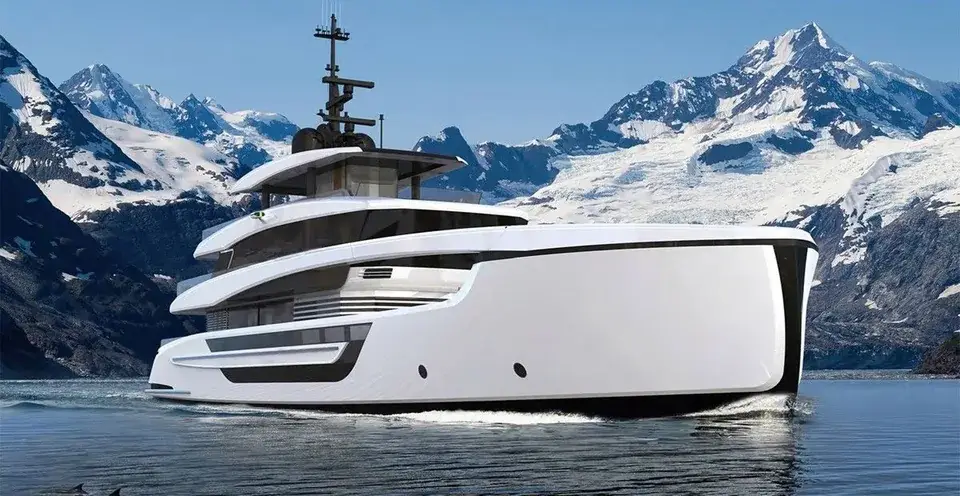
After sea trials for the new steel explorer, Amer is putting one figure at the centre of the story: 60 litres per hour in Eco Mode at 9.5 knots on a 42-metre yacht.
Article outline
The most useful part of the Amer 42 Explorer story is not its length or the familiar promise of going farther. It is that a 41.45-metre steel explorer is being led by a sea-trial consumption figure: 60 litres per hour in Eco Mode at 9.5 knots, according to Amer Yachts, using Volvo Penta's IPS Professional Platform. If that number proves repeatable in normal operations, it gives the sub-500 GT explorer market a sharper language: less romance about range, more scrutiny of how each mile is actually produced.
For owners, captains and buyers, Amer 42 Explorer Even Further is worth watching because it moves efficiency from the back of the specification sheet to the front of the commercial argument. It does not prove that every explorer yacht should use the same propulsion layout. It does show that hull form, displacement, propulsion and operating speed are becoming measurable selling points, not background engineering.
Amer leads with fuel burn, not top speed
Amer Yachts says Even Further has completed her first open-sea trials from Sanremo. The yacht is the yard's first steel vessel and the founding model for its new custom steel production line. The confirmed figures from the builder are precise enough to matter: 41.45 metres overall, aluminium superstructure, 440 tonnes at full load, Ice Class notation, two IPS40 drives and four Volvo Penta D13 engines meeting IMO Tier III standards.
The headline figure is not maximum speed. It is fuel burn: 60 litres of diesel per hour in Eco Mode at 9.5 knots, with two of the four engines connected to the pod drives. Amer links that mode to a declared 8,900-nautical-mile range from 56,300 litres of fuel. BOAT International reported on 15 July 2026 that the yacht had been launched and completed sea trials, also noting accommodation for ten guests in five cabins.
Those are builder and trade-report figures, not an independent long-passage fuel audit. They should be treated as verified reported data, not as a universal promise for every sea state, hotel load or routing decision.
IPS in steel is the technical move to watch
Volvo Penta had already described the Amer 42 Explorer as the first sub-500 GT displacement superyacht with a steel hull built around the IPS Professional Platform. That is the point that makes this more than a launch note. IPS drives have long been familiar on smaller planing and semi-displacement yachts; here the system is being applied to a heavy long-range platform where efficiency, redundancy and service logic matter more than a fast headline number.
There is no magic in pod propulsion. It demands integrated design, access planning, protection, crew familiarity and a clear maintenance strategy. But when hull, weight distribution and propulsion are developed as one system, reduced propulsive losses can become a real operational advantage for an owner who cruises at displacement speeds.
That is why Even Further belongs in the same conversation as more established Italian superyacht references without being directly comparable to them. A look atBenetti and the Italian large-yacht traditionframes the classical end of the market; Amer is pushing the efficiency claim closer to the centre of the brief.
Range is only useful when the operating mode is credible
The declared 8,900-nautical-mile range is the number most likely to travel through the market, but it is also the number that needs the most careful reading. Yacht range is never a single fixed quality. It depends on speed, displacement, weather, stabilisation, generators, air conditioning, reserves, routing and crew management.
The practical value of Amer's claim is not that every owner will attempt an extreme non-stop passage. It is that the yacht gives the owner and captain a defined efficient mode around which to plan. That changes the question from "how much fuel can the boat carry" to "what passage can the boat sustain at a disciplined energy cost".
This matters for resale as well. Buyers increasingly understand that a coherent efficiency story is stronger than large tanks alone. A Mediterranean owner comparing long-range intent with comfort-led cruising can use references such asAzimutto see how different builders balance volume, design language and onboard technology.
The missing beach club says something about purpose
Available fleet descriptions also point to a design choice that deserves attention: Even Further is not built around the now-standard beach club. YachtBuyer describes a layout where that space is effectively traded for an expanded flybridge and exterior areas tied to privacy, tenders and operating flexibility. The yacht is also associated with two 8-metre tenders, a clue to the programme she is meant to support.
That decision will not suit every owner. In the current market, the beach club is almost a social requirement on many large yachts. But for an explorer yacht, deleting or reducing that feature can be coherent if the boat needs storage, tender handling, technical access and outdoor living in remote anchorages.
The comparison should be about use case, not hierarchy.Ferretti Yachtsspeaks to a different flybridge cruising culture, whileRivaremains a benchmark for image and finish. Amer's message is more operational: less theatre at the stern, more useful miles and deck logic.
What owners should ask after the launch
Even Further does not settle the efficiency debate. It makes the debate more specific. A buyer should now ask for consumption across several speeds, hotel-load data at anchor and underway, noise and vibration levels, pod access procedures, spare-part planning and service coverage along the intended cruising region.
Captains will want to know how the system behaves outside the best-case Eco Mode: manoeuvring, crosswinds, rough water, fouling, generator loads and long intervals between major service stops. Brokers will need to convert the efficiency story into residual value without overselling a single sea-trial number.
For the broader market, Amer has done something useful. It has put an identifiable engineering claim in public view at a time when explorer yachts are often sold through atmosphere, renderings and vague sustainability language. The next serious explorer launch will have to answer with numbers of its own.
Sources and references
Sources consulted and references retained to verify data and context.
- AMER YACHTS REDEFINES THE BOUNDARIES OF YACHTINGAmer Yachts · 2026-06-29
- First Amer 42 Explorer Even Further launched and completes sea trialsBOAT International · 2026-07-15
- Superyacht with IPS professional platformVolvo Penta · 2025-12
Continue reading
406 MHz EPIRB and PLB: choosing, registering and testing
September 27, 2026 · 7 min read
Navigation lights: inspect and test them aboard
September 26, 2026 · 7 min read
Boat reboarding ladders: test them from the water
September 25, 2026 · 7 min read