Sustainable marine fuels and the case for existing boats
NMMA’s latest update on sustainable marine fuels shifts the debate from green promise to real compatibility with engines, tanks, range and marina supply.
Article outline
NMMA's July 18 update is not a promise that every marina will suddenly become carbon-light. Its more practical message is that sustainable marine fuels could give the existing fleet a lower-emission route without forcing every owner into a full propulsion replacement.
A technical signal from Atlantic City
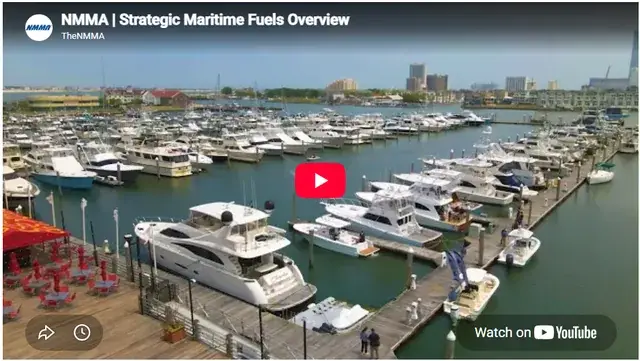
The National Marine Manufacturers Association published a new video on sustainable marine fuels after a June demonstration in Atlantic City, hosted by Viking Yacht Company at Golden Nugget State Marina. The confirmed message is deliberately broad: recreational boating is moving through a portfolio of technologies, including cleaner liquid fuels, electric propulsion, hybrids, hydrogen, advanced engines and better vessel design.
That breadth matters. Boats do not behave like cars. A cruising powerboat, a sportfisher or a family weekender can demand high power for long periods, often far from charging points or specialist energy infrastructure. For many owners, the fuel question is therefore not a lifestyle slogan. It is a question of range, availability, warranty confidence and resale value.
That is why the discussion is relevant beyond the American market. Buyers comparing established cruising brands, fromBeneteau family cruisers and day boatstoJeanneau coastal and weekend models, are not only choosing layouts. They are buying into an operating system made of engines, tanks, service networks and fuel access.
Why drop-in fuels attract attention
NMMA highlights renewable diesel, also known as HVO, and biobutanol in partially renewable gasoline blends. The important phrase is drop-in: these fuels are intended to work in existing engines and fuel systems without a structural conversion of the boat.
That does not remove every responsibility from the owner. Drop-in is an industrial compatibility claim, not a free pass to ignore manuals, engine maker guidance or marina fuel specifications. A diesel owner still needs to know whether the engine manufacturer accepts the fuel being supplied. A petrol owner still needs to understand the blend, storage behavior and any service guidance.
The appeal is clear all the same. If a fuel can reduce lifecycle emissions while preserving range and familiar handling, it reaches boats that battery-only solutions cannot easily reach today. HVO is interesting because it is positioned as a renewable diesel alternative. Biobutanol is interesting in marine petrol because it is described as more stable around water than ethanol, avoiding the phase-separation concern that has long made boaters cautious.
The fleet already afloat is the hard part
New boats can be designed around fresh assumptions. Existing boats cannot. That is the strategic value of sustainable marine fuels: they address the installed base. A ten-year-old cruiser, a lightly used flybridge or a marina berth full of conventional engines will not become irrelevant overnight, and most owners will not repower a good boat simply because the fuel debate has moved on.
For the mid-market, including boats comparable withBavaria cruising models, the first barrier is distribution. A compatible fuel that appears in only a handful of locations changes very little. A fuel that becomes available on reliable seasonal routes can start to influence cruising plans, charter operations and maintenance habits.
The Atlantic City demonstration matters because NMMA framed it around real marine conditions and on-water demonstrations. That is the right test environment. Marine fuel is stored in humid tanks, used at variable loads, exposed to seasonal lay-up and judged by whether the boat performs when the weather window opens.
Where the claim should stay modest
There is no confirmed global marina rollout in NMMA's July 18 article. There is no price guidance, no European timetable and no universal instruction that owners should switch tomorrow. Batoo's analysis is therefore cautious: the news is important because it shows where industry advocacy and testing are concentrating, not because it settles the fuel transition.
For larger motor yachts, the implications are even more operational. Owners reviewingAzimut motor yacht optionsor comparing the market aroundFerretti Yachtsalready think in terms of tankage, passage range, generator load and service support. A lower-emission fuel that keeps those operating assumptions intact is easier to evaluate than a technology that rewrites the whole usage profile.
The key is documentation. A brokered boat with clear service records, fuel-system maintenance, engine bulletins and evidence of proper storage will be easier to assess than one sold with vague sustainability language. Fuel innovation helps the market only when it becomes traceable.
Practical questions before the next fill
Owners considering HVO, biobutanol blends or any sustainable marine fuel should ask four precise questions. Is the fuel approved or accepted by the engine manufacturer for that specific engine family? What standard or blend is being supplied by the marina? How should the boat be stored between uses or over winter? Will the use of that fuel affect warranty, service records or insurance discussions?
Those questions are not obstacles to adoption. They are the route to adoption. Recreational boating needs lower-emission options that preserve the reasons people own boats in the first place: range, reliability, freedom of movement and confidence at sea.
The most credible reading of the NMMA update is not that one fuel will win. It is that the next phase of cleaner boating will be plural. Batteries, hybrids, hydrogen and improved hulls will matter. Sustainable marine fuels may matter because they can reach the boats already moving through marinas this summer.
Sources and references
Sources consulted and references retained to verify data and context.
- WATCH: NMMA Video Highlights the Promise of Strategic Maritime FuelsNational Marine Manufacturers Association · 2026-07-18T00:00:00Z
- Strategic Maritime FuelsPropelling Our Future
- U.S. Recreational Boating Industry Begins Rolling Out Sustainable Marine Fuels with Pilot Program in FloridaNational Marine Manufacturers Association · 2024-07-02T00:00:00Z
Continue reading
406 MHz EPIRB and PLB: choosing, registering and testing
September 27, 2026 · 7 min read
Navigation lights: inspect and test them aboard
September 26, 2026 · 7 min read
Boat reboarding ladders: test them from the water
September 25, 2026 · 7 min read