Boat batteries: a safe DC system inspection
A structured inspection of battery banks, fuses, isolators, terminals, restraint and ventilation, with a clear boundary between owner checks and electrical design.
In brief
To inspect boat batteries, map the installed system, isolate every source by the documented procedure, then check restraint, terminals, conductors, fuses, switches and ventilation. Never uprate a fuse that keeps opening, and do not treat lithium as a drop-in replacement: overheating, redesign and protection calculations belong with a competent marine electrician.
Article outline
A battery that still cranks the engine can sit inside an unsafe installation. The weak point is often not the battery’s stored energy but the route it takes through terminals, conductors, fuses, switches and distribution: looseness, poor restraint or the wrong protective device can turn an ordinary load into heat and damage.
This inspection is a way for an owner to ask better questions, not a licence to redesign a DC system. The battery maker’s instructions, the boatbuilder’s diagram and the rules that apply to the vessel remain controlling; unfamiliar isolation steps and any sign of overheating call for a competent marine electrician.
Draw the live system before opening the locker
Begin by identifying the engine battery, domestic bank and any dedicated bank, then trace chargers, alternators, solar controllers, inverters, main fuses and isolators. Photograph each compartment and sketch both positive and negative routes. The exercise frequently exposes direct-to-terminal accessories and old branches that no label explains.
Record the declared chemistry, nominal voltage, product model and available manual for every bank. Those entries do not determine cable or fuse sizes by themselves, but they let an installer check whether charging sources, the battery-management system, conductors and protective devices belong in the same design.
Shut down loads by the vessel’s established procedure, disconnect shore supply and prevent an accidental engine start before inspection. A boat can retain energy from more than one source, so do not remove a terminal simply because a selector says OFF. If the diagram is missing, treat that uncertainty as the first defect to resolve.
Keep jewellery and uninsulated tools away from exposed terminals. The useful outcome is an intelligible map in which each important conductor has a known origin, destination and duty; an unidentified cable should be investigated, not silently reconnected.
Match overcurrent protection to the fault path
Batteries can supply very high fault current. A fuse is intended to stop excessive current before a conductor overheats or a short circuit continues feeding a fire, which is why a main bank fuse and downstream branch protection do not perform the same task.
An ampere figure alone is insufficient. Victron’s Wiring Unlimited identifies current rating, voltage rating, interrupt rating, operating speed and fuse type as selection factors, and states that voltage rating must meet or exceed the system’s expected maximum. Available short-circuit current is especially important with lithium banks, where an installer must compare the protective device’s interrupt capability with the designed fault level.
Look for bypassed fuses, darkened holders, loose fasteners, warped insulation and replacement parts with unreadable markings. Never increase a fuse rating simply to stop nuisance opening. Repeated operation is evidence to diagnose; oversizing may leave the protected conductor exposed beyond its design.
Physical placement matters too, because the positive length between a battery and its protection remains part of the fault path. The permitted arrangement depends on the applicable standard, conductor routing and any defined exception. Measure and document it, then have a qualified person assess it rather than applying a remembered universal distance.
Make isolation obvious before an emergency
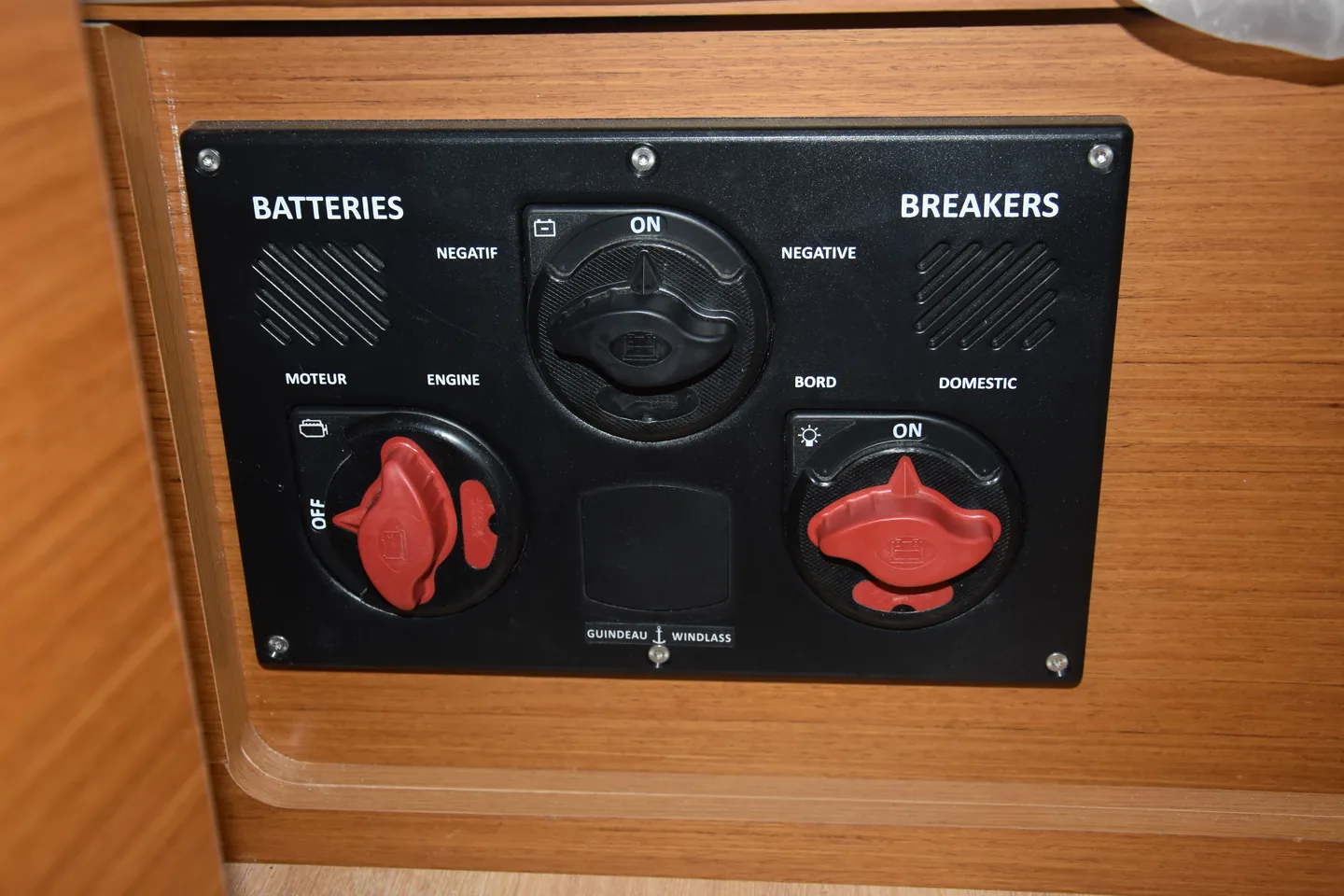
A battery switch can isolate a bank or a consumer for servicing and incident control, but not every switch is designed to break DC current under load. Victron advises checking DC voltage, continuous current, short-duration ratings and the manufacturer’s switching specification. A large red handle is identification, not proof of capability.
Confirm that controls are accessible and their purpose is obvious to someone new to the boat. Engine, domestic and other supplies need unambiguous labels. Britain’s Boat Safety Scheme includes rapid disconnection and visible or marked isolator operation among its safety principles; that is useful inspection evidence, but its inland-waterway requirements are not automatically the law for a vessel elsewhere.
Plan a functional test around the manuals. Determine which loads must stop, which source is being isolated and whether any safety-critical circuit intentionally remains live. If a switch is hot, cracked, stiff or intermittent, stop the test rather than forcing it.
Verify the meaning of OFF against the diagram and with suitable instruments. A bilge pump, alarm or charging route may be deliberately wired outside a domestic selector; such an exception is not inherently wrong, but it must be intentional, protected and recorded so the crew understands what still carries energy.
Inspect restraint, terminals and the locker
A battery needs positive restraint against vessel motion rather than reliance on its own weight. Examine straps, brackets, trays and their attachment points. Scuffed cases, polished patches or displaced hardware are evidence of movement that deserves correction.
The Boat Safety Scheme examines battery security and, within its own regime, checks movement in every direction. Its detailed procedures also direct examiners to look for missing or loose parts, exposed strands, heat damage and corrosion at cable connections. Permanent leads should use appropriate purpose-made connections, not temporary crocodile clips.
Do not treat green or white deposits as a purely cosmetic job. After safe isolation, the cause may involve moisture, electrolyte, incompatible metals or a poor seal, and the joint may require replacement rather than cleaning. Terminal protection must also prevent a dropped tool, metal lid or stored spare from bridging live parts.
Cables should not be taut, crushed or able to chafe on an edge. Pay particular attention near bilges: the BSS procedure calls for visible connections to sit above bilge-water level or receive suitable watertight protection. Historic tide marks can reveal a risk even when the bilge is dry during the visit.
Ventilation must follow chemistry and installation instructions. BSS standards require adequate ventilation for compartments holding unsealed or open-vented batteries so that a flammable gas mixture cannot build up. Do not block vents with spares, yet do not assume a sealed label makes any hot, enclosed location acceptable; manufacturer limits and the complete compartment design still matter.
Treat a lithium conversion as a system refit
Replacing lead-acid with lithium is not a box-for-box substitution. Charging control, battery management, temperature limits, protection, monitoring and the available fault current all interact; alternator, mains charger, solar controller and inverter must be evaluated as one installation.
The Boat Safety Scheme’s installed-lithium guidance recommends marine-suitable equipment, competent installation to appropriate standards and strict observance of product instructions. It names ISO 13297 and ISO 23625 and warns against connecting different battery types together in series or parallel. Owners still need to check flag, builder, local and insurer requirements for their particular vessel.
A BMS is not a universal safety certificate. Its permitted charging and discharging logic must coordinate with every connected source and load as the manufacturer intends. The crew should understand shutdowns and alarms, including what a disconnect could do to propulsion support or essential services.
Swelling, physical damage, unusual heat, vapour or abnormal noise is a reason to stop using the battery and obtain specialist help, not to run a home experiment. For a conversion, request an updated schematic, component models and settings, protection calculations, isolation instructions, commissioning results and a crew briefing.
Finish with controlled tests and a written defect list
Close the inspection by ranking observations according to risk. Heat marks, acrid odour, a distorted case, sparking, damaged cable or an unstable connection justify keeping the affected circuit out of service until a competent person examines it. Missing labels and records may be less immediate, but they still undermine safe isolation.
Recommission in an agreed order: restore sources, confirm expected voltage, add loads individually and watch for alarms or abnormal voltage behaviour with proper instruments. Do not use a hand as a temperature probe on suspect high-current equipment, and do not tighten an energised connection as a diagnostic shortcut.
Batoo’s analysis separates owner-level observation from engineering judgement. Owners can preserve access, cleanliness, labels, records and routine visual checks; cable sizing, fault-current assessment, protection changes and overheating diagnosis require system data and the relevant standard.
Repeat the survey after electrical work, water ingress, a hard impact or a meaningful change in loads, keeping photographs from the same angles. A dependable DC installation is not one that merely worked yesterday; it is one where every major path has an explained purpose, suitable protection and a demonstrable isolation method.
Sources and references
Sources consulted and references retained to verify data and context.
- Wiring Unlimited — DC wiringVictron Energy
- The Boat Safety StandardsBoat Safety Scheme
- BSS Core Examination Checking Procedures, Part 3Boat Safety Scheme
- Lithium-ion Battery Safety on Boats: Installed BatteriesBoat Safety Scheme
- Main battery switches in a sailboat — photographWikimedia Commons · 2018-09-24