Shore Power: A Safer Connection Routine
A disciplined routine for checking leads and connectors, managing demand, connecting in a safe order and recognising the warning signs that require immediate isolation.
In brief
For safer shore power, confirm compatibility and condition while everything is off, connect the boat end first and disconnect the shore end first. Manage loads instead of relying on the breaker alone. Heat, burning smells, noise, blackening, tingling or repeated trips require immediate isolation and assessment by a qualified marine electrician.
Article outline
Shore power is often treated as a plug-and-forget convenience. Yet the connection joins a damp, moving boat to a land supply through cable, plugs, protective conductors and switching devices that all have to remain sound. An owner’s safest contribution is a repeatable operating routine: confirm compatibility, inspect what can be seen, connect in a controlled order and stop at the first credible warning.
This is an operational guide for an existing installation, not a wiring design or compliance certificate. Voltage, frequency, connector patterns and protection rules vary by jurisdiction and marina, so the boat manual, equipment labels and berth instructions take priority whenever they are more restrictive.
Start with an unpowered compatibility check
Read the pedestal label and the boat inlet before taking the cable out of its locker. The stated voltage, frequency and current rating must suit the boat, cable and any approved adapter. Mechanical fit alone proves nothing about electrical compatibility; an unreadable label or unfamiliar outlet is a reason to ask the marina, not to experiment.
Inspect the whole lead while it is disconnected. Look for cuts, cracks, heavy abrasion, flattened insulation, exposed conductors, taped repairs, bent pins, loose strain reliefs, darkened contacts and distorted plastic. UK Health and Safety Executive guidance identifies burn marks and staining as evidence of overheating and says damaged leads should be replaced by a competent person rather than repaired with tape or an unsuitable connector.
The connection hardware deserves equal attention. Locking rings, weather seals and cable grips should be complete and should hold without forcing. US Coast Guard guidance calls for shore leads suitable for marine service, locking plug-and-connector ends and weather protection; it warns that ordinary outdoor extension cords are not suitable for this marine duty. Where an adapter is accepted by the equipment maker and marina, the Coast Guard places it at the shore end, not as an improvised chain beside the boat inlet.
Connect so that no loose end is live
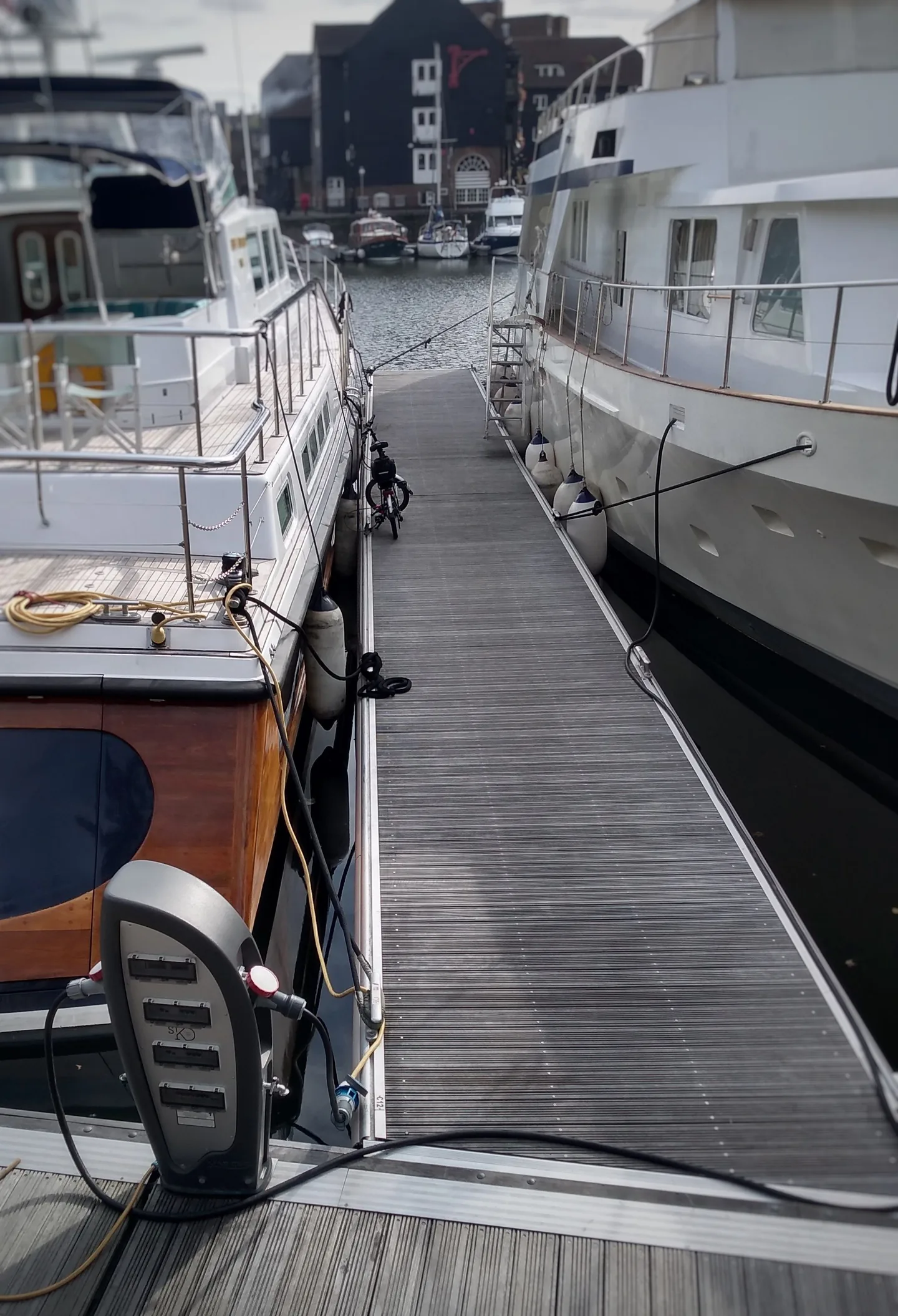
Turn off the boat’s AC main breaker and substantial appliances first. With the pedestal supply off, connect the boat end fully and secure its locking arrangement; route the lead without putting it in the water, crushing it or pulling it tight. Connect the shore end only after the boat end is secure, then energise the pedestal as the marina directs.
Reverse that order when leaving. Remove or switch off loads, open the boat’s main breaker, turn off the pedestal, disconnect the shore end and only then remove the boat end. This Coast Guard sequence prevents a live free connector from being left on the dock where it might fall into the water. Pull the plug body rather than the cable, and keep uncapped ends protected from rain and spray.
Routing is not housekeeping; it is part of the electrical control. Keep the lead away from hinges, sharp edges, wheels and walking routes where it could be damaged or become a trip hazard, following its maker’s instructions. Protect connectors from water and mechanical strain rather than leaving the line’s weight hanging from them.
Manage demand without trusting the breaker alone
A socket rating is a ceiling, not a target. Decide which large appliances may run together and bring them online one at a time while observing the panel and connections. Water heating, cabin heating, air conditioning and cooking can create a large combined demand; if a breaker opens, reduce demand and investigate rather than repeatedly resetting it.
Residual-current protection reduces risk from certain faults but does not make damaged equipment acceptable. HSE guidance says an RCD detects some faults rather than every fault and treats repeated tripping as evidence to check the system, never a nuisance to bypass. Its general workplace guidance cites a trip current no greater than 30 mA for personal protection. That figure is not a universal boat-compliance setting: marine standards, installation architecture and local rules may specify different layers or thresholds.
Overload, short-circuit and residual-current protection solve different problems. The UK Maritime and Coastguard Agency’s code for fishing vessels under 15 metres—used here as a technical reference, not as recreational law—requires clear identification, separation of AC and DC systems and circuit protection, and points to ISO 13297 for small-craft AC installations. Only a qualified marine electrician should assess protective-earth continuity, polarity, insulation resistance and coordination between boat and shore protection.
Treat heat, smell and unexpected trips as stop signals
Unusual warmth, a hot plug, a burning smell, crackling, a new buzz, sparks, blackening or repeated trips require isolation, not observation until the end of the stay. Turn off power without handling a suspect wet or hot component, notify the marina if the pedestal may be involved and keep the system off until the fault is understood. UK government boat-fire guidance similarly tells users to watch for scorch marks, burning smells and buzzing or crackling, then switch off and obtain a check.
Tingling felt from metalwork is an emergency warning. Do not enter the water and do not directly grab someone who may still be exposed to electrical current. Arrange an immediate supply shutdown from the marina’s safe isolation point, call emergency services and keep others clear of the water until competent responders declare it safe.
A breaker that remains closed does not prove a connector is healthy. A loose or corroded contact can develop intense local heating without immediately exceeding the whole circuit’s rated current. Once isolated, record where the heat or damage appeared and have both mating parts assessed; replacing one scarred plug while leaving its damaged socket can preserve the original fault.
Build inspection history, not just a memory
Make the visual check part of every connection and set deeper inspection intervals from manufacturer instructions, usage and exposure. Record dates, the lead used, defects, protective-device operations and repairs. A short log helps an electrician connect intermittent symptoms that different crew members might otherwise dismiss as unrelated.
Use test buttons at the interval and in the manner specified for the fitted device, remembering that a button exercises its intended mechanism rather than certifying the entire installation. Insulation resistance, protective-conductor continuity, polarity and leakage measurements belong to a competent technician with suitable instruments. Within its own scope, the MCA code requires insulation testing before a new or altered installation enters service; the useful lesson for a leisure owner is that visual neatness cannot validate electrical work.
The final decision should be conservative. Connect only when the supply, cable, connectors and installed system are compatible, intact and behaving normally. When evidence is incomplete, stay disconnected, reduce energy use and obtain qualified help. Batoo’s analysis is that this simple refusal threshold delivers more safety than an extra adapter or a habitual breaker reset ever could.
Sources and references
Sources consulted and references retained to verify data and context.
- Boating Safety Circular 81 — Shore Power Cords: Proper Use and MaintenanceUnited States Coast Guard
- Fire safety on boats (accessible version)UK Government · 2022-05-25
- Work using electrically powered equipmentUK Health and Safety Executive
- Code of Practice for the Safety of Small Fishing Vessels under 15mUK Maritime and Coastguard Agency · 2024-01-31
- Boating Safety Circular 80 — Do Not Install Generator Sets on the CheapUnited States Coast Guard · 1998-12-01
Continue reading

Lightning aboard: avoidance, response and checks
October 22, 2026 · 7 min read

Boating in fog: sound signals, radar and Rule 19
October 20, 2026 · 7 min read
Radar reflectors for small craft: choice, mounting and limits
October 18, 2026 · 7 min read