Radar reflectors for small craft: choice, mounting and limits
How to assess RCS, X- and S-band coverage, heel, mounting height and inspection of a radar reflector without mistaking it for a detection guarantee.
In brief
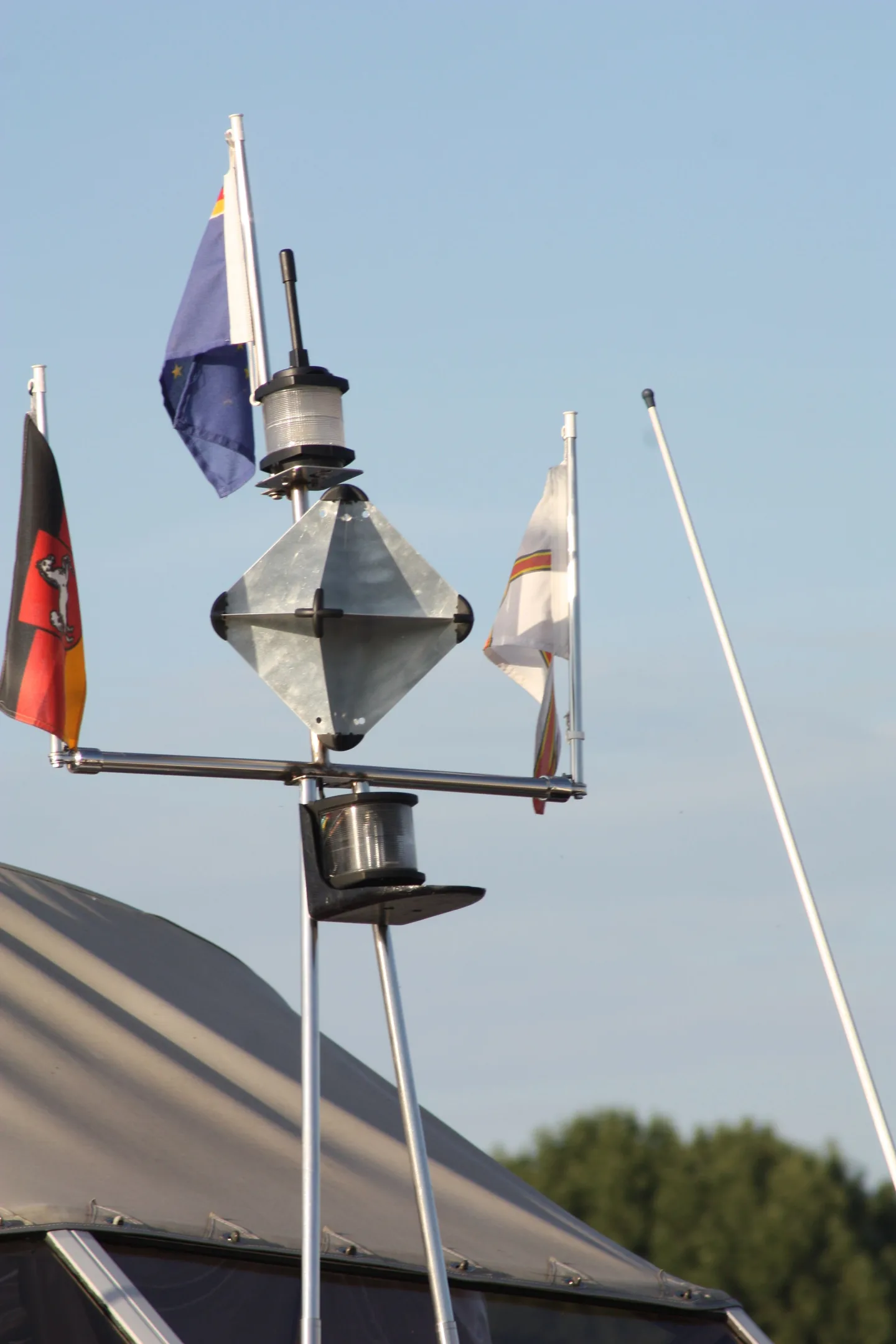
Choose a radar reflector by checking documented RCS in X- and S-band, performance at heel, required orientation and achievable height. A powered RTE may give a more consistent response but depends on electricity. No unit guarantees detection, so permanent mounting, routine inspection and a proper lookout remain essential.
Article outline
A radar reflector is best treated as a probability improver, not an invisibility cure. A sound installation begins with documented performance in the radar bands used by ships, accounts for heel and orientation, and remains part of the boat's inspection routine. A compact object with an impressive peak figure may still be a poor target from important bearings.
The return matters more than the casing
Marine radar transmits energy and listens for the portion returned by a target. Radar cross section, or RCS, expresses that echoing ability by comparison with a reference, but it is not the boat's physical area. Hull material, superstructure, target aspect, heel, sea state, atmosphere, range and the interrogating radar all influence whether an operator receives a useful trace.
The UK Maritime and Coastguard Agency's 2022 guidance distinguishes X-band radar at about 9 GHz from S-band radar at about 3 GHz. Commercial ships may use both, so an X-band-only claim does not establish S-band performance. Product evidence is more useful when it identifies the band, test standard, azimuth coverage and heel angles instead of presenting one maximum RCS number.
Consistency is the neglected quality. A reflector can have a strong peak and deep gaps as the boat turns, rolls or sails heeled. Owners should therefore read polar plots or independent test results when available and ask what happens between the best headings.
A standard is a benchmark, not a fitting plan
MCA notice MGN 349 Amendment 1 summarises the IMO MSC.164(78) benchmark. It gives minimum RCS values of 7.5 square metres in X-band and 0.5 square metres in S-band when the reflector is mounted at least 4 metres above sea level. It also sets azimuth coverage and null limits, with performance maintained through specified heel ranges.
The notice associates those requirements with ISO 8729-1:2010. It also acknowledges the practical tension: equipment meeting the full standard can be large for a vessel under 15 metres. For smaller craft, the MCA recommends considering the most effective appropriate reflector the boat can safely accommodate and discusses the older EN ISO 8729:1998 reference in a defined approval context.
Regulatory scope deserves care. SOLAS Chapter V Regulation 19 uses an “if practicable” provision for ships below 150 gross tonnage, yet national implementation and exemptions are jurisdiction-specific. This article uses the published MCA figures as a technical comparison; an owner should confirm carriage obligations with the flag administration and local rules rather than treating a product label as legal advice.
Passive reflector or powered enhancer
A passive reflector needs no electrical supply. Its attraction is availability: once correctly mounted and undamaged, it does not depend on a switch or battery. Its challenge is physical size and geometry, because useful returns must be maintained across the directions and heel angles the boat will encounter.
A radar target enhancer, usually shortened to RTE, receives a radar pulse, amplifies it and retransmits a response. MGN 349 says an RTE can create a larger equivalent RCS from a smaller body and deliver a stronger, more consistent indication. The trade-off is dependence on power, wiring and functional checks.
Band coverage is decisive. The MCA identifies X-band-only and dual X/S-band enhancers and warns that an X-only unit will not answer a ship relying on S-band, such as in heavy rain. Before choosing, verify the exact model rather than assuming every active product covers both frequencies.
A useful shortlist asks four things: are X- and S-band results documented; what happens at realistic heel; can the unit be mounted as instructed without unsafe loads or interference; and, for an RTE, how will the crew detect lost power or a fault? These questions expose limitations before they become surprises offshore.
Mounting height and orientation shape the result
The MCA recommends permanent installation as high as practicable, ideally at least 4 metres above the water. Its notice associates that height with a potential minimum detection range of 5 nautical miles for X-band and 3.7 nautical miles for S-band. “Potential” is essential: waves, rain, masking, vessel attitude and radar settings can shorten or interrupt detection.
Orientation must match the manufacturer's instructions. MGN 349 uses the passive reflector's “catch rain” position as an example of a configuration that improves performance. A reflector loosely hoisted for an encounter can rotate, swing or sit in the wrong plane, while a permanent bracket can keep its intended geometry if it is strong enough and properly maintained.
The surrounding installation matters too. A mast, standing rigging, the boat's own radar, solar panels or other equipment may mask sectors or complicate the return. There is no universal clearance that solves every mast layout; the product manual and a competent structural assessment should govern when weight or windage aloft is material.
What the 2007 QinetiQ testing can still teach
The QinetiQ work commissioned after the Ouzo accident remains valuable as a lesson in test method. It compared actual reflectors and separated peak response, average response, nulls and performance at heel. Those measures did not always rank products in the same order, demonstrating why a headline maximum is an incomplete buying criterion.
One especially small 4-inch tube reflector performed poorly in that programme. The broader lesson is not that every current tube is identical, but that compactness and visual similarity cannot substitute for evidence. A result belongs to the tested model, arrangement and conditions.
The report is dated 2007, so it should not be used as a 2026 shopping list. Product versions, availability and standards can change, and its period prices are historical. Batoo's analysis is to use the report as a framework for questions, then require current data for the precise model offered today.
The MAIB investigation into the loss of Ouzo reinforces the limitation. Its technical assessment found that deploying the reflector carried aboard would probably not have changed the yacht's overall RCS very much in the circumstances examined. Merely owning a device therefore says little about the strength and consistency of the protection it provides.
Inspect the installation and preserve the lookout
Record the manufacturer, exact model, supported bands, required orientation and mounting location. At routine inspections, check brackets, fasteners, corrosion, cracks, water entry and deformation, and make sure sails or running rigging cannot foul the unit. For an active enhancer, include circuit protection, cables, connectors, status indication and the maker's test procedure.
Reassess after mast work or after adding antennas and panels. An informal check against another vessel's radar may reveal a gross failure, but it cannot certify RCS or reproduce a laboratory test. If the echo varies while the boat turns slowly, record the band, weather, range and headings; the exercise can expose sensitivity without pretending to prove compliance.
Finally, keep the device in its proper place in the collision-avoidance system. The MCA explicitly warns that a small craft may still be hard to see even with a reflector or RTE and says the equipment does not replace a proper lookout. Navigation lights, AIS and radio each answer different needs; none turns a radar reflector into a guarantee.
Sources and references
Sources consulted and references retained to verify data and context.
- MGN 349 (M+F) Amendment 1: Navigation safety — carriage and use of radar reflectors on small vesselsUK Maritime and Coastguard Agency · 2022-10-04
- Performance investigation of marine radar reflectors on the marketQinetiQ for the Marine Accident Investigation Branch
- Report on the investigation of the loss of the sailing yacht Ouzo and her three crewUK Marine Accident Investigation Branch
Continue reading
Lightning aboard: avoidance, response and checks
October 22, 2026 · 7 min read

Boating in fog: sound signals, radar and Rule 19
October 20, 2026 · 7 min read
Compass deviation: checking and correction cards
October 15, 2026 · 6 min read