Compass deviation: checking and correction cards
A practical method to separate declination from onboard deviation, test several headings, record a correction card and recognise when professional adjustment is needed.
In brief
To check compass deviation, set up the boat as normally operated and remove loose magnetic objects. Batoo’s method compares at least eight steady headings with an independent reference, recording signed error and equipment state on a dated card. Bubbles, irregular readings or large changes call for a qualified compass adjuster; do not move correctors experimentally.
Article outline
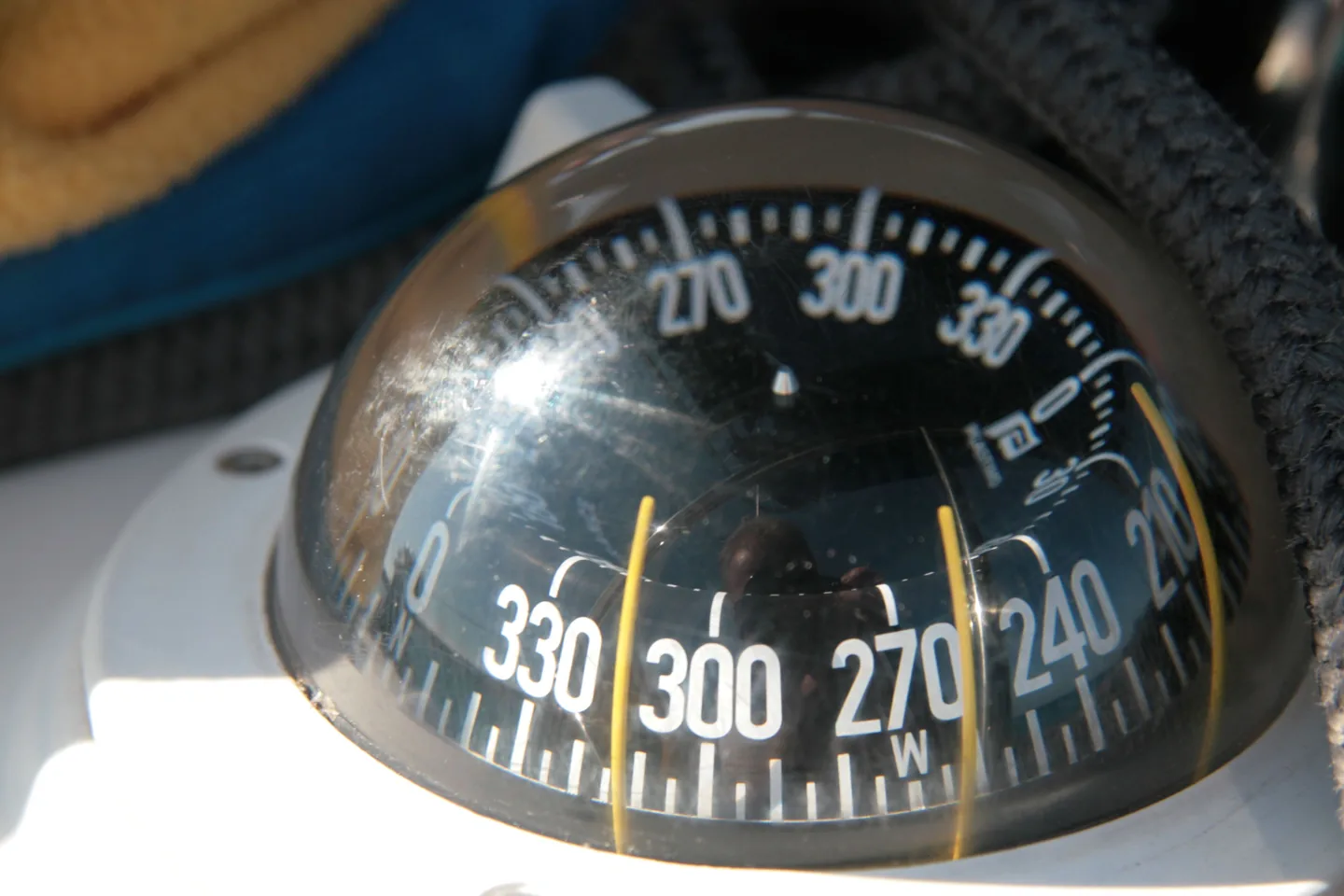
A magnetic compass remains valuable on a boat fitted with GPS and a chartplotter because it can show heading without electrical power. Its reading is not automatically correct, however. A useful check separates the Earth’s magnetic declination from deviation created aboard the boat, records the latter around the compass rose, and leaves adjustment of compensating magnets to a qualified specialist.
Separate declination from onboard deviation
True north is the geographic reference; magnetic north is the direction indicated by the horizontal component of the Earth’s field. NOAA defines magnetic declination, also called variation, as the angle between them and says it changes with both place and time. Use a current chart or an authoritative geomagnetic calculator for the test position and date rather than copying an old value from a logbook.
Deviation is local to the vessel. Ferrous masses and electrical or magnetic equipment distort the field at the compass, and the resulting error commonly changes as the boat’s head turns. A deviation card therefore lists corrections for a series of headings; a single correction written beside the helm cannot describe a heading-dependent pattern.
Write the conversion convention on the worksheet before collecting numbers. One clear arrangement records compass heading, east or west deviation, magnetic heading, east or west declination, and true heading in separate columns. NOAA’s stated convention adds positive east declination and negative west declination to a magnetic bearing to obtain true; another convention can work, but mixing sign rules cannot.
Freeze the normal operating configuration
Prepare the boat as it is actually navigated. Stow tools, portable anchor gear, cylinders and safety equipment in their usual locations, and decide which electrical equipment is normally running at the helm. The objective is not an artificially empty boat but a repeatable baseline that can be described on the finished card.
Inspect the compass before manoeuvring. Confirm that the lubber line appears aligned with the vessel’s fore-and-aft line, the card can be read from the steering position, and the dome has no obvious damage. Transport Canada’s small-vessel guidance also calls for checking that a wet compass has no bubbles, keeping it away from electrical interference and checking accuracy after changes to the vessel.
Move phones, handheld radios, tools and loose steel away while establishing the baseline. Then introduce necessary portable items one at a time and compare readings. The UK Maritime and Coastguard Agency specifically warns that portable electrical equipment and steel objects can affect a compass; a visible change when one object moves is a reason to relocate or investigate that object, not to reach immediately for the compass correctors.
Test relevant circuits deliberately. Record readings with nearby electronics, wipers, blowers or other regular loads in their normal states, then change one state at a time. This is a diagnostic comparison, not proof of the precise physical cause. An intermittent error should be removed at its source or assessed professionally rather than hidden by a correction that works only when a particular switch is on.
Make a controlled swing and keep raw observations
Choose open water, good visibility, low traffic and conditions in which heading and speed can be held steadily. Use a heading reference independent of the compass being checked: a correctly identified charted transit viewed on its line is one option, while a separately verified heading system is another. GPS course over ground should not be treated automatically as heading because current, leeway and a turning track can separate the direction travelled from the direction the bow points.
Batoo’s owner-check method uses at least eight headings spread around the horizon. Hold each heading long enough for the boat and display to settle, then write down compass heading, independent reference, signed difference and equipment state at once. Eight points are a practical editorial screening pattern, not a claim that a professional compass swing has been completed.
Check reciprocal headings and repeat several points while turning the other way. If the same nominal heading produces materially different readings, do not average the disagreement into a neat table. Sea state, steering, an unsuitable reference, a moving metal object or compass friction may have spoiled the run; identify the instability and repeat the observation.
Retain the original worksheet. The operational deviation card can show compass heading, east/west deviation, corresponding magnetic heading and the date, but the raw notes preserve the test conditions. Interpolation between tested headings is reasonable only where the curve is smooth; a sudden step deserves investigation rather than cosmetic smoothing.
Diagnose patterns without adjusting blindly
An almost constant offset on every heading may point toward alignment or reference error, whereas a changing pattern is consistent with vessel-induced magnetic deviation. This is Batoo analysis for triage, not a sufficient basis for moving correctors. IMO performance standards contemplate correcting devices for several distinct components of ship magnetism, which is why adjustment is a skilled procedure rather than a one-screw calibration.
Compare equipment-on and equipment-off runs. If an error appears only with one device energised, document the device, heading and observed magnitude, and have its installation, separation distance and wiring assessed. Correcting the compass around a temporary electromagnetic disturbance could improve one configuration while worsening the normal one.
MCA guidance says required compasses should be properly adjusted and have their residual deviation table or curve available. It identifies first installation, unreliability, structural work, nearby electrical or magnetic equipment changes, and certain lapses in monitoring as reasons for adjustment; it also highlights monitoring after a vessel has been idle. Recreational skippers can use these as prudent triggers, while checking the actual rules applicable to their flag, vessel and waters.
Escalate defects and preserve the result
Stop an owner check when the compass contains bubbles, sticks, returns inconsistently, oscillates abnormally or produces large irregular errors. Stop as well if a recent impact, structural alteration, battery move, new speaker or rewiring could have changed the magnetic environment. Transport Canada says adjustments should be made by a qualified compass adjuster, and MCA guidance likewise places regulated adjustment with appropriately certified people in its jurisdiction.
Do not open the bowl or move compensators experimentally. Give the adjuster the old deviation card, raw observations, normal equipment states and a list of recent alterations. Those records allow a reproducible investigation and prevent a technician from calibrating an equipment configuration that the boat never uses.
After service, obtain a dated card that identifies the specific compass and operating configuration. Keep it at the steering position, brief crew on the sign convention, and compare the compass periodically with independent observations. The realistic goal is not a magical zero-error instrument: it is a known, stable residual error that can be applied correctly and a documented threshold for seeking help when the pattern changes.
Sources and references
Sources consulted and references retained to verify data and context.
- MGN 610 (M+F) Amendment 1: guidance on magnetic compassesUK Maritime and Coastguard Agency · 2025-02-13
- Resolution A.382(X): Magnetic compasses carriage and performance standardsInternational Maritime Organization · 1977-11-14
- Magnetic DeclinationNOAA National Centers for Environmental Information
- TP 10038 – Small Fishing Vessel Safety ManualTransport Canada · 2003-01-01
- Yacht compass photographWikimedia Commons · 2009-10-05
Continue reading

Lightning aboard: avoidance, response and checks
October 22, 2026 · 7 min read

Boating in fog: sound signals, radar and Rule 19
October 20, 2026 · 7 min read

Radar reflectors for small craft: choice, mounting and limits
October 18, 2026 · 7 min read