406 MHz EPIRB and PLB: choosing, registering and testing
A source-grounded guide to choosing an EPIRB or PLB, registering its identity, mounting it correctly, self-testing safely and managing batteries, false alerts and disposal.
In brief
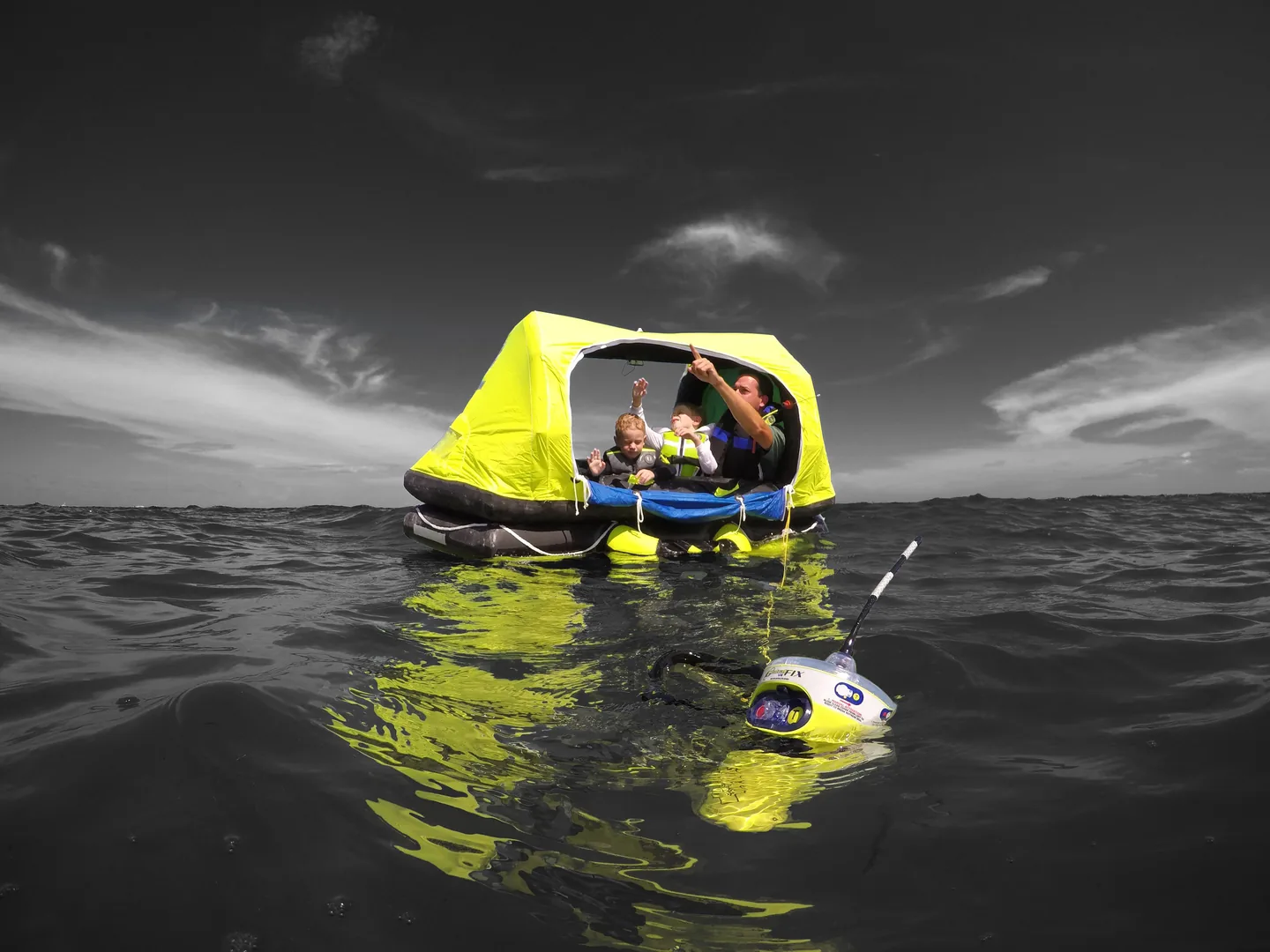
An EPIRB primarily protects the vessel and may release automatically; a PLB stays with an individual and is manually activated. Both need correct country coding, current registration and self-testing strictly under the manufacturer’s instructions. Check the battery, bracket and hydrostatic release against their service dates, and report any accidental activation immediately to the responsible rescue coordination authority.
Article outline
A 406 MHz beacon is best treated as a rescue system, not as another item on the safety-equipment list. Its signal, unique identity, registration record, mounting position and crew knowledge all have to work together when a normal passage turns into abandonment or a person is separated from the boat.
Start with the casualty you need to cover
An EPIRB is a maritime beacon associated with a vessel; a PLB is a portable beacon intended to stay with an individual. That difference matters more than their similar controls. It determines whether the system is meant to alert after the vessel is lost, or to follow one person who may be in the water, a tender or a remote anchorage.
Float-free EPIRBs can release and activate automatically when their housing is submerged, provided the bracket has been mounted where the beacon can reach the surface. Manual EPIRBs need someone to retrieve and switch them on. PLBs are manually activated, so the wearer must remain capable of reaching and operating the unit.
For a crewed cruising boat, Batoo’s analysis is that the vessel EPIRB and the personal PLB solve different failure modes. A PLB can add individual coverage, but it should not casually be treated as a substitute for an EPIRB where the boat’s rules or operating profile call for one. Carriage obligations vary by flag, vessel class and voyage, and should be checked with the responsible administration.
Prioritise a beacon with an integrated GNSS receiver, because its digital alert can include the position calculated by the beacon. Check the approved specification for features such as an AIS locating signal, strobe or Return Link Service instead of relying on packaging shorthand. The country coding must also suit the registry that will hold the beacon record.
Registration turns an alert into usable intelligence
The transmitted identity links the radio alert to the information supplied by the owner. That record can tell rescue coordinators what craft to look for, how many people may be involved and whom ashore to call for route or equipment details. Product warranty registration and retailer records do not perform this rescue function.
Look for the HEX ID or UIN printed on the beacon and its label. First-generation identities normally contain 15 hexadecimal characters, while second-generation units may carry a 23-character identity. Copy the code exactly; do not infer it from the serial number, MMSI or model designation.
Registration belongs with the authority for the beacon’s country code. The information requested varies, but useful records commonly include vessel name and description, communications equipment, capacity and reachable emergency contacts. Keep a photograph of the label and the registry confirmation somewhere accessible away from the vessel so an identifier can be supplied after loss of the boat.
The record is a living part of the system. Update it after a change of owner, vessel, telephone number or emergency contact, and follow the national procedure when a beacon is sold or retired. A good shore contact knows the current passage plan and is not one of the people sailing, allowing the first call from a rescue centre to add information rather than ring the casualty.
The UK’s 2026 framework is a useful example of why local rules matter. The Maritime and Coastguard Agency says EPIRBs and PLBs carried within the scope of the rules on UK ships, hovercraft and watercraft must be registered; its registry can also record several uses or vessels for a PLB. This is a jurisdictional example, not a claim that the same filing details apply everywhere.
Mounting must preserve the release path
A float-free EPIRB cannot work automatically if it is fitted inside a cabin, trapped beneath a closed cover or blocked by loose deck gear. Select a position where the housing can be submerged as the vessel sinks and the released beacon can rise unobstructed. At the same time, respect the maker’s limits for impacts, environmental exposure and bracket orientation.
Do not tie the beacon’s lanyard permanently to the vessel or its mounting bracket. MCA inspection guidance calls for the lanyard to be present, in good condition and neatly stowed; it is there to secure the floating beacon to survivors or a liferaft after release. Permanent attachment to a sinking hull defeats that purpose.
Manual beacons need a different access test. Imagine smoke, darkness, a severe heel angle and only seconds to leave: a unit at the bottom of a locked locker is not readily available. Every regular crew member should be shown the release, the antenna position, the lanyard and the difference between self-test and distress controls.
Routine visual inspection should include the casing, antenna, bracket, markings and signs of water ingress. On an automatic installation, include the hydrostatic release and its expiry. After handling the beacon, refit it correctly and confirm that no transmission has started.
Test the electronics without sending a distress alert
Use only the manufacturer’s self-test procedure for routine owner checks. NOAA states that the operational Cospas-Sarsat system is not intended for live testing; an activation outside self-test is interpreted as distress unless specially authorised. The correct light or sound sequence and the allowed test frequency are model-specific, so they must come from the current manual.
Record the date and result rather than repeatedly testing until a preferred indication appears. A sensible inspection log also notes casing condition, registration status, battery expiry, bracket security, lanyard condition and hydrostatic-release expiry where fitted. Run a GNSS self-test only as instructed, because it can use more battery capacity than a basic internal test.
Treat the battery as a certified service component. U.S. Coast Guard guidance says it should be replaced by the date on the label, using the manufacturer-specified model and an approved dealer; the wrong battery may not support the required distress duration. Follow the manual for replacement after a real activation and for any earlier service trigger.
MCA guidance for the EPIRBs within its non-SOLAS maintenance regime calls for shore-based maintenance at intervals no longer than five years. That work includes competent personnel, calibrated equipment, approved spares and a watertightness check. It is not a universal owner-service interval: the beacon approval, flag rules and manufacturer’s instructions remain controlling.
Respond correctly to real and accidental activation
Activate a beacon for grave and imminent danger when assistance is required. Give the antenna a clear view, keep the unit in its designed operating attitude and allow a floating EPIRB to float if survivors are in the water. Continue using VHF, visual signals and any other available means, because they can communicate the nature of the casualty while the beacon supplies an alert and identity.
If a beacon is triggered accidentally, switch it off and contact the appropriate rescue coordination authority immediately. Provide the beacon identity and state clearly that there is no distress; do not wait for officials to call, because even a short transmission may already have entered the response chain. Put the correct national or regional contact in the vessel’s emergency plan before sailing.
Retirement also needs a controlled process. NOAA advises making a discarded beacon inoperable, normally by removing its battery where possible, then returning it to the manufacturer or physically disabling it; the registry record must be updated as well. Dispose of the battery and electronics under applicable local waste rules rather than placing an intact transmitter in general rubbish.
The final readiness check is therefore a chain: correct country coding, current registration, appropriate mounting, valid service dates, a successful authorised self-test and a crew that knows the controls. A new beacon with stale data or a blocked release route is not fully ready. Reliability comes from maintaining the system around the transmitter.
Sources and references
Sources consulted and references retained to verify data and context.
- 406MHz Emergency Distress BeaconsNOAA SARSAT
- Frequently Asked QuestionsNOAA SARSAT
- Emergency Position Indicating Radiobeacon (EPIRB)U.S. Coast Guard Navigation Center
- MGN 673 (M+F): Radio communications: non-SOLAS vesselsUK Maritime and Coastguard Agency · 2023-01-31
- MGN 665 (M+F) Amendment 1: Mandatory registration of EPIRBs and PLBsUK Maritime and Coastguard Agency · 2026-03-24
Continue reading
Navigation lights: inspect and test them aboard
September 26, 2026 · 7 min read
Boat reboarding ladders: test them from the water
September 25, 2026 · 7 min read
Bilge pumps: testing, inspection and flooding response
September 24, 2026 · 6 min read