Boat fire extinguishers: selection, placement and checks
A reasoned guide to portable boat fire extinguishers: how to read approvals, place units along an escape route, inspect them and know when not to fight a fire.
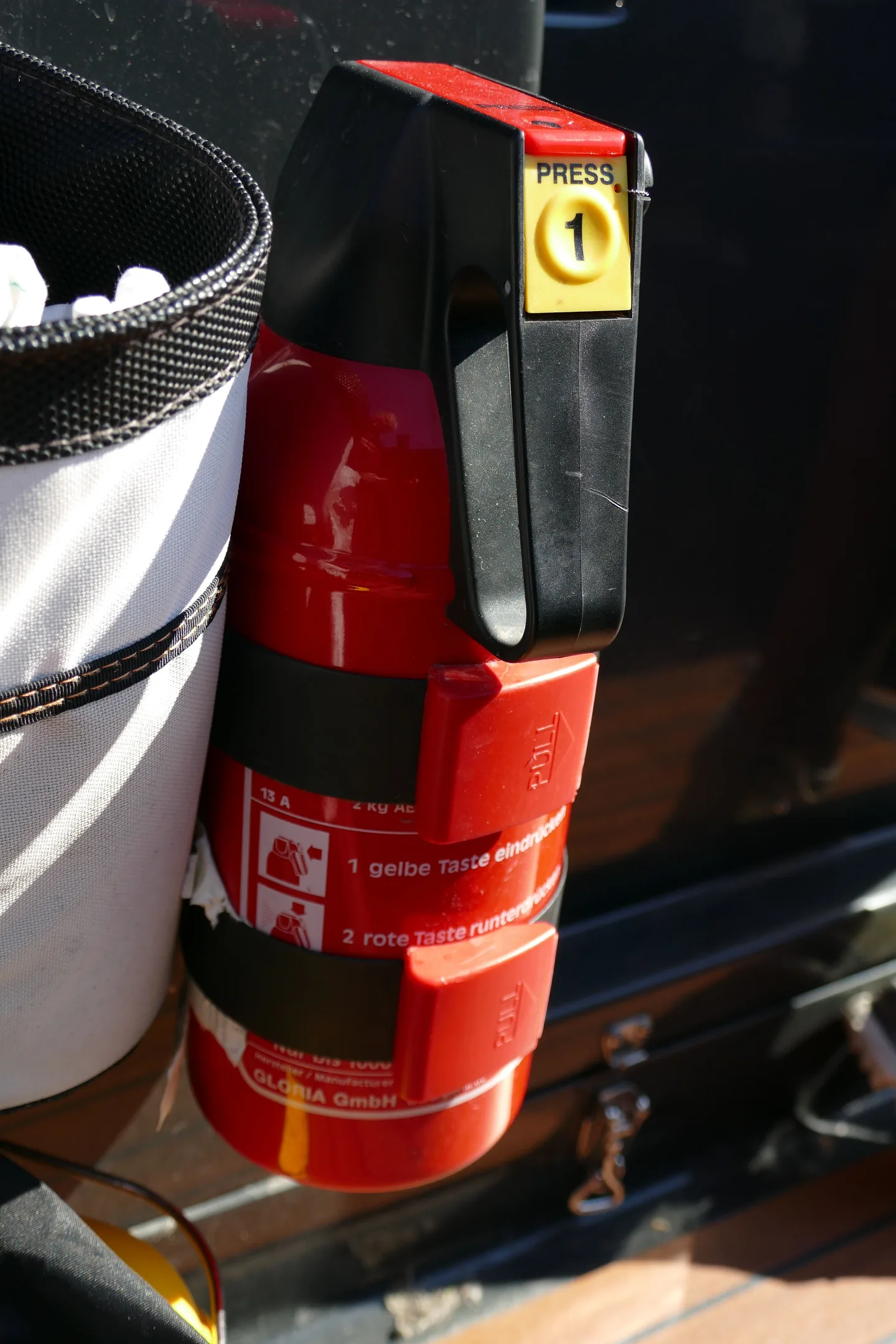
In brief
An effective marine extinguisher is not chosen by capacity alone: it must carry the appropriate approval, remain reachable without crossing the fire, and be visibly serviceable. Check pressure, pin, nozzle, corrosion, damage and the maker’s service dates regularly. Tackle only a small fire while keeping an escape route behind you; smoke, uncertainty or rapid growth means raise the alarm and evacuate.
Article outline
A charged extinguisher can still be the wrong extinguisher if flames stand between it and the crew. Fire readiness on a recreational boat is therefore a layout and decision problem as much as an equipment problem: suitable units, reachable positions, meaningful inspections and an agreed point at which everyone stops fighting and leaves. Flag-state rules and product instructions remain controlling; the method below is intended to organise those obligations, not replace them.
Match the unit to the hazards aboard
Start with a walk through the boat rather than a shopping list. Machinery spaces, battery installations, cooking appliances, heaters and flammable-liquid lockers create different conditions, so the approval label, fire rating and extinguishing medium deserve closer attention than colour or advertising. Record what can ignite, what can burn and whether a person could approach without becoming trapped.
United States rules illustrate why boat configuration matters. The U.S. Coast Guard says extinguishers are required on recreational boats with permanently installed fuel tanks or enclosed spaces capable of trapping vapours. Its FAQ also describes a narrow exception for an outboard boat under 26 feet with a portable tank and no space where vapour can collect; required quantities otherwise vary by boat length and whether the machinery space has a fixed system.
Those figures are not a universal shopping table. A European-flagged boat, a charter vessel or a craft operating under local inland rules may face different approvals and carriage requirements. Confirm the current rule for the vessel’s flag and use, then check that every unit’s label actually meets it; where the installation has changed, a competent marine professional should resolve uncertainty.
Put escape before convenience
An extinguisher should be encountered on the way away from danger, not retrieved by walking towards it. UK government fire guidance advises keeping extinguishers and fire blankets readily accessible near exits and risk points such as the galley and engine area. That principle exposes a common weakness: a compliant unit buried behind stores or mounted beyond the likely seat of fire has little operational value.
Test the arrangement from each sleeping berth and from the helm. A person should be able to raise the alarm, reach an exit and collect a suitable extinguisher while retaining a clear route behind them. On a divided interior, distributing units is generally more resilient than clustering everything beside one companionway; location signs and a torch should remain visible after normal cruising gear is loaded.
The bracket has two jobs that must not be traded against each other. It must restrain the cylinder through vibration and boat motion, yet release without a puzzle in poor light. Follow the manufacturer’s specified bracket and orientation: the Coast Guard notes that mounting is not always compulsory under its rule, but ready accessibility is, and some product labels make validity conditional on the supplied bracket.
Inspect for an actionable result
A useful inspection produces one of three decisions: available, service required or replace now. The Coast Guard defines good serviceable condition through observable points: a gauge or indicator in its operating range, a secure locking pin, an unobstructed nozzle and no significant visible corrosion or damage. A unit that appears partly discharged should not remain in the ready count.
Marine conditions justify looking beyond the gauge. Examine the base, neck, hose, trigger, safety seal and the area hidden by the retaining strap; salt can attack places that are invisible from the aisle. A green pointer cannot excuse a dented cylinder or cracked hose, just as clean paint cannot make low pressure acceptable.
Batoo’s recommended practice is to log date, location and outcome, then attach the maker’s service instruction to the vessel file. This is an editorial recommendation rather than a universal legal interval, but it turns a glance into traceable maintenance and helps a new skipper understand what was actually checked. Any anomaly should be judged against the label by a qualified service provider, not corrected with improvised parts.
Age rules must be tied to their jurisdiction. In the United States, the Coast Guard says a disposable portable extinguisher bearing a UL mark and manufacturing date expires after 12 years and must leave service; rechargeable units instead follow their inspection and servicing regime. Do not export that 12-year figure to every flag: manufacturer instructions, recognised service centres and the applicable authority determine the answer elsewhere.
Understand what the discharge changes
Extinguishing medium affects the compartment as well as the flame. UK guidance specifically warns that dry powder can produce a dense cloud that cuts visibility and impairs breathing. On an open deck that drawback may be manageable; in a narrow cabin it can obscure the exit and make an already confused situation worse.
A fixed machinery-space system also changes tactics. Opening a hatch can supply air to the fire, and the UK advice is to avoid opening engine hatches or doors unless necessary. Transport Canada separately states that, under its requirements, an automatic system does not remove the need to carry the prescribed portable units; fixed protection and portable escape support are different layers.
Know the remote shutdowns for engine, fuel and electricity before an emergency, but never reach through heat or smoke to operate them. Prevention remains the stronger layer: sound wiring, maintained fuel connections, supervised cooking and working alarms limit the chance that a portable cylinder becomes the crew’s last option. In Batoo’s analysis, the best equipment plan is built around likely movement and isolation, not simply the largest combined rating.
Fight only while the exit remains yours
A portable extinguisher is for an incipient fire, not for searching a smoke-filled compartment. UK government guidance says not to enter smoke and tells people who are unsure to get out, stay out and call for help. For a fire offshore it advises moving everyone as far from the fire as possible on deck, putting on lifejackets, taking a handheld VHF and notifying the coastguard.
If the fire is limited, the medium is appropriate and escape remains open, Transport Canada directs the user to aim at the base and sweep from side to side. Its guide also recommends continuing briefly after visible flames are gone because the fire can restart. That technique does not override the withdrawal cues: worsening heat, thickening smoke, loss of orientation or an ineffective first discharge should end the attempt.
Crew briefing makes this decision faster. Before departure, show every person the exits, portable radio, lifejackets, isolation controls and extinguishers; identify who sends the distress call and who accounts for people. A dry rehearsal, without operating an extinguisher, often reveals a jammed strap or blocked path that no certificate can detect.
Turn the inventory into a working system
Give each unit a simple record containing position, medium, approval, rating, manufacture date, next service or retirement date and last inspection. A clear photograph of the label helps with replacement, but it cannot show current pressure or hidden corrosion. Once an extinguisher has been used, even briefly, treat it as unavailable until a disposable unit is replaced or a rechargeable one is professionally restored.
Repeat the access check after loading for a trip. Bags, food boxes and an inflatable tender can transform an open locker into an obstacle course, while a changed berth cushion can hide a location label. The final test is not whether the boat owns enough red cylinders; it is whether a crew member can recognise the event, reach the correct unit with a retreat behind them, make one controlled attempt and abandon it before the fire takes away that choice.
Sources and references
Sources consulted and references retained to verify data and context.
- Fire Extinguishers Requirements for the Recreational Boater FAQU.S. Coast Guard
- Fire safety on boats (accessible version)UK Government
- Safe Boating Guide – Safety Tips and Requirements for Pleasure CraftsTransport Canada
Continue reading
406 MHz EPIRB and PLB: choosing, registering and testing
September 27, 2026 · 7 min read
Navigation lights: inspect and test them aboard
September 26, 2026 · 7 min read
Boat reboarding ladders: test them from the water
September 25, 2026 · 7 min read