Navigation lights: inspect and test them aboard
A practical method for checking the configuration, sectors, lenses, power supply and real visibility of a boat’s lights before a night passage.
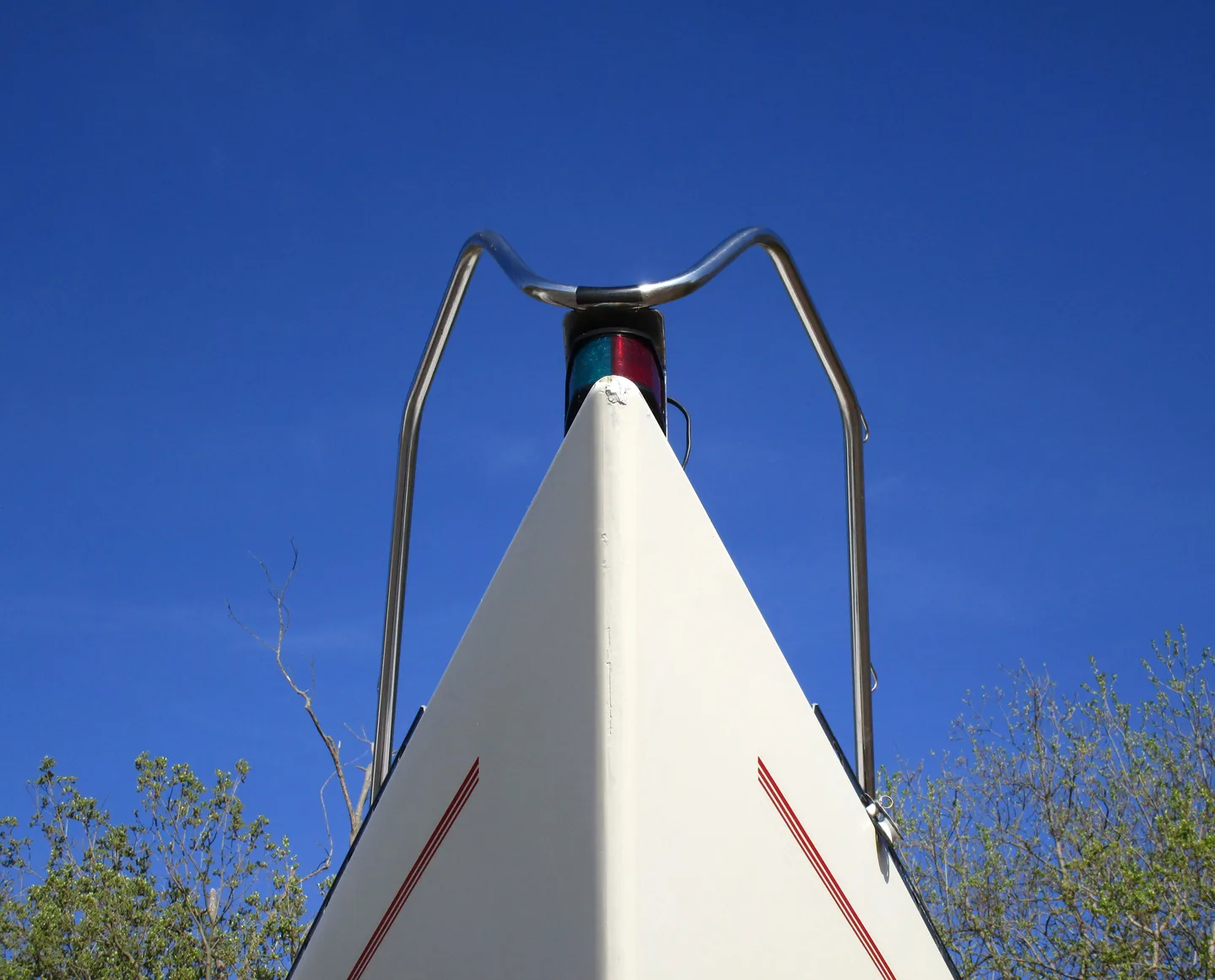
In brief
Checking navigation lights means more than switching them on at the berth. First match the displayed combination to the boat’s length, propulsion and operating condition; then inspect lenses, seals, screens and wiring. After dark, observe the sectors from ahead, abeam and astern, look for masked angles, and repeat the test with the engine, radio and normal electrical loads running.
Article outline
A glowing lantern is not proof of a sound navigation-light system. A hazed lens, a tired connection or a rail crossing the beam can leave another skipper with a misleading picture of the boat’s heading and status.
Define the display before inspecting the hardware
Start with the message the vessel is required to show. COLREG lights apply from sunset to sunrise and must also be displayed in restricted visibility during daylight; the correct pattern changes with vessel length, means of propulsion and operational condition. Write those variables down before removing a cover or ordering a replacement lamp.
Rule 23 allows a power-driven vessel under 12 metres to show an all-round white light and sidelights instead of the full larger-vessel arrangement. A sailing vessel underway follows Rule 25, while a yacht using its engine as well as sails is treated as power-driven for the navigation rules and has a separate daytime shape requirement. Small-craft exceptions are precise, so they should never be extended by intuition or copied from a boat of another size.
Make a three-line display plan for the actual boat: power-driven underway, sailing underway where relevant, and at anchor. Add any genuine operating condition the vessel may enter, and identify which switch produces each pattern. Testing isolated bulbs without testing the required combination can leave a perfectly bright but legally incoherent display.
Arcs and ranges turn light into information
Rule 21 defines a masthead light over 225 degrees, each sidelight over 112.5 degrees and a sternlight over 135 degrees. Those sectors let an observer interpret aspect rather than merely notice a bright object. A fitting mounted off-axis, tilted by a loose base or missing its screen may reveal colours together where a clean cut-off was intended.
Rule 22 adds minimum luminous ranges. On vessels under 12 metres, masthead and stern lights have a 2-nautical-mile minimum and sidelights a 1-mile minimum; from 12 to under 50 metres, sidelights and the sternlight require 2 miles, while the masthead light is generally 5 miles, reduced to 3 for vessels under 20 metres. These are selection and compliance figures, not a guarantee of what a person will see through rain, spray or background lighting.
Annex I joins colour, intensity, vertical position and sector cut-off into one performance requirement. Fitting a nominally brighter bulb is therefore not a dependable upgrade: its filament may sit in the wrong focal position, its output may not suit the coloured optic, and glare may increase. Preserve the tested lantern-and-source combination stated by the manufacturer.
Conduct a cold inspection in daylight
Isolate the circuit and inspect the outside first. Look for cracks, salt deposits, clouding, condensation, faded coloured material and a distorted seal; confirm that fasteners and cable entries remain secure. Transport Canada’s maintenance guidance specifically treats condensation as evidence that a gasket is leaking and calls for regular cleaning and inspection.
Next check alignment and masking. Centreline marks should agree with the hull’s axis, sidelight screens should be intact, and an all-round light should not disappear behind a mast, aerial, flag or folded canopy. Re-create the sailing condition too: a raised tender, loaded stern, open sprayhood or people in the cockpit can introduce shadows that are absent in the yard.
Open a serviceable lantern only as its instructions permit. Examine terminals, the holder, the dedicated fuse and the negative return for movement, heat damage or corrosion. A sealed fitting that has admitted water is not an invitation to drill a drain hole; an improvised repair can change both its protection and its optical performance.
Treat an LED conversion as an optical change
Low consumption and long nominal life make LEDs attractive, but the source and lens operate as a system. UK Maritime and Coastguard Agency guidance warns that retrofitting an LED source into an existing lantern may invalidate that lantern’s type approval and tells owners to consult the manufacturer. A matching cap and voltage do not establish correct colour, intensity or sector distribution.
The MCA also notes that some LED navigation lights can decline gradually rather than fail abruptly. Where there is no alarm or manufacturer-defined replacement interval, its guidance describes periodic intensity checks at intervals not exceeding five years for the relevant LED units. For a leisure boat, the defensible approach is to retain the product documentation and replace the complete fitting when an approved source substitution cannot be demonstrated.
Radio noise deserves a separate check. Tune the VHF to a weak but intelligible transmission, switch each lighting circuit on and off, and listen for a repeatable loss of reception; do the same with AIS reception if the equipment provides a meaningful diagnostic view. This onboard comparison is not an electromagnetic-compatibility certification, but it can reveal a fault that a visual lamp test will never show.
Observe the boat from outside after dark
Run the meaningful test in darkness at a safe location where the display will not confuse traffic. Have a second person view the boat from dead ahead, both bows, each beam and astern, whether from shore or a tender operated safely. Note where each colour appears and disappears; this is a screening exercise for obvious overlaps and blind areas, not a substitute for photometric measurement.
Repeat the circuit with the boat arranged for passage. Put the canopy, sails, dinghy and crew where they will actually be, then inspect reflections from pulpits, guard wires, white decks and windscreens. A light can remain visible to others yet damage the helmsman’s own night vision through internal glare.
Load the electrical system as it will be loaded at sea. Start the engine, operate the instruments, radio and routine pumps, and watch for flicker or unexpected dimming while vibration is present. If voltage is measured at the lantern, use safe methods and compare the result with the maker’s limits; a no-load battery voltage by itself says little about the complete circuit.
Keep evidence that survives the next refit
Finish with a compact record containing the date, conditions, displays tested, defects found and parts fitted. Photograph the final orientation and screens, and retain the model number, approval information and instructions. That trail helps prevent a future owner or yard from replacing a failed component with something that merely looks equivalent.
Before any trip likely to continue after sunset, perform a switch-panel check and walk outside to confirm the lights themselves. At planned maintenance points, repeat the physical inspection, angular observation and loaded electrical test. Salt exposure, vibration, operating hours and the manufacturer’s instructions should determine frequency; Batoo analysis does not invent one universal interval.
Stop treating the job as a DIY check when the required pattern, product approval or installation geometry cannot be established. A competent marine electrician can diagnose supply and installation faults, while the flag or local authority is the proper source for jurisdiction-specific requirements. Other vessels respond to the pattern they can see, not to the reassuring glow on the switch panel.
Sources and references
Sources consulted and references retained to verify data and context.
- Convention on the International Regulations for Preventing Collisions at Sea, 1972 (COLREGs)International Maritime Organization
- USCG Amalgamated Navigation Rules: Part C, Lights and ShapesUnited States Coast Guard Navigation Center
- Annex I: International Positioning and Technical Details of Lights and ShapesUnited States Coast Guard Navigation Center
- MGN 393: Navigation Light Units, Maintenance and New Technology Light SourcesUK Maritime and Coastguard Agency · 2010-01-01
- TP 14070: Small Commercial Vessel Safety Guide — Navigation Lights MaintenanceTransport Canada · 2010-01-01
Continue reading
406 MHz EPIRB and PLB: choosing, registering and testing
September 27, 2026 · 7 min read
Boat reboarding ladders: test them from the water
September 25, 2026 · 7 min read
Bilge pumps: testing, inspection and flooding response
September 24, 2026 · 6 min read