The Great Loop compresses a season of wear into one nonstop run
Scheduled to launch on 8 August, the Great Loop Challenge targets more than 7,300 nautical miles—a hard field test for engines, systems, crew and logistics.
Article outline
The 2026 Great Loop Challenge was scheduled to leave DeLand, Florida, on 8 August with a target that shifts attention away from peak speed and towards continuity: more than 7,300 nautical miles, running day and night across inland waterways, coasts, lakes and locks. The specified boat is a customised Portā DARK:30 Velocity powered by twin Honda BF350 V8 outboards. Until a return to its starting point is documented, however, this remains an announced attempt, not a record secured.
That distinction matters. Such a long run can reveal useful evidence about high-power outboard reliability, but only if the sporting narrative is followed by intelligible data: engine hours, fuel use, stops, maintenance, average speeds and the nature of any failures. For an owner, the stopwatch alone is not the prize. The value lies in seeing how a complete system absorbs fatigue, changing environments and operational mistakes.
One route, many different load cases
The announced course includes rivers, lakes, locks, bays, Intracoastal sections and open-water legs. Planned calls include Tampa, Key West, the Wrightsville Beach-Wilmington area, Portland and Halifax. The crew intends to operate around the clock outside planned stops. Honda also notes that recreational crews normally complete the Great Loop over months rather than days.
That variety makes the exercise more revealing than a long steady-state run. Current, depth, debris, speed restrictions, lock delays and rough water impose sharply different loads. Engines may move from prolonged high output to repeated transients; the hull alternates among planing, displacement speeds and close manoeuvring. Fuel quality and ambient temperature can also change across such an extensive route.
This is not a controlled comparison. There is no identical reference boat, no repeatable weather and no published measurement protocol. The Great Loop Challenge 2026 should therefore be read as a high-intensity field trial: excellent at exposing weak points, less suited to proving absolute superiority.
Twin BF350s are only part of the machine
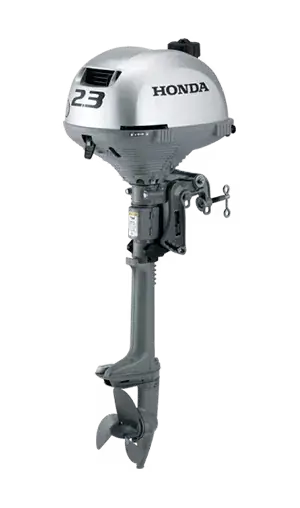
Official material identifies two Honda BF350 V8 outboards and says that partner technologies have been integrated into the boat. The headline figure—two 350 hp engines—describes only one layer of the system. Fuel delivery and filtration, batteries, charging, cooling, steering, propellers, navigation electronics and service access matter just as much during nonstop operation.
Two engines provide a get-home possibility that one cannot, but redundancy does not eliminate common-mode failures. Contaminated fuel, shared electrical faults or impacts with submerged objects can affect both sides. This is where the DARK:30 installation becomes interesting: not merely how fast it runs, but how effectively circuits are separated and how diagnosis or repairs can be performed under way. Those details are not documented in the available sources, so attributing specific solutions to the boat would be premature.
Prospective cruising-boat owners can use the run as a lens rather than a template.Beneteau cruising rangesemphasise longer stays aboard, whileJeanneau models for coastal useoffer another comparison. Neither builder is reported as participating in the challenge; these references simply show how speed, range and accommodation are balanced differently in production boats.
Human endurance is part of the specification
Continuous navigation turns crew management into an engineering variable. Watch rotations, sleep, food, noise and vibration all affect decision quality. A boat that remains efficient while the people aboard lose acuity is not yet a safe system. The course adds traffic, darkness, changing weather and repeated transitions between different authorities and infrastructure.
An experienced crew led by Captain Scott “Red” Flowers is confirmed. The sources reviewed do not publish watch plans or fatigue-management procedures. It is therefore fair to recognise the human challenge without presenting assumptions as reporting. The owner-level lesson is direct: practical endurance is the duration that crew, systems and spares can sustain together.
Comparing ordinary cruising platforms makes the contrast clearer. ABavaria designed around measured passagesprioritises space and pace very differently from a marathon boat, whileFountaine Pajot cruising catamaransdistribute volume and redundancy in another way. These builders are editorial points of reference only, not event partners.
The finish needs a transparent data set
The release describes an attempt to establish a time benchmark and a campaign supporting paediatric cancer research. The project therefore has two legitimate objectives, sporting and charitable. To produce transferable technical knowledge as well, the final account should separate at least four groups of figures:
- actual distance travelled and total engine hours;
- fuel loaded, total consumption and consumption by leg;
- planned stops versus delays caused by weather, traffic, refuelling or repairs;
- work performed on engines, propellers, filters, electrical systems and structure.
Average speed through the water and over the ground, encountered conditions and the precise timing method would also be valuable. Without that frame, a fast completion remains an impressive feat of seamanship and logistics, but says little about the energetic and mechanical cost of the performance.
Endurance racing is not routine ownership
The tempting editorial shortcut is to turn survival in an exceptional event into a promise about everyday use. The duty cycles are very different. The DARK:30 is being operated by professionals on a planned route with support and scheduled calls. A private boat spends far more time idle and accumulates thermal cycles, moisture, fouling and deferred service. An engine may survive continuous running yet suffer from seasons of inactivity and repeated short starts.
That is why the meaningful result will not simply be “finished” or “did not finish”. It will be the wear map: which components required attention, under what conditions and with what operational consequences. If organisers and partners publish granular data, the Great Loop can become a rare piece of real-world validation. If only the elapsed time appears, the run will retain sporting and charitable value but cannot serve as a universal reliability certificate.
With the announced departure time now past, technical judgement must still wait for a documented return—and, more importantly, for the log of everything that happened between DeLand and DeLand.
Sources and references
Sources consulted and references retained to verify data and context.
Continue reading
406 MHz EPIRB and PLB: choosing, registering and testing
September 27, 2026 · 7 min read
Navigation lights: inspect and test them aboard
September 26, 2026 · 7 min read
Boat reboarding ladders: test them from the water
September 25, 2026 · 7 min read