Sailboat jacklines and tethers: design and inspection
How to design, route and inspect sailboat jacklines and tethers, accounting for working paths, tether reach, hook loading and recovery of a person still attached.
In brief
An effective jackline should keep the sailor on deck, allow clipping on before exposure and connect work stations with few transfers. It needs structural anchors, an inboard route and the shortest tether leg compatible with the task. Inspect webbing, stitching, hooks and the overload indicator, then rehearse how the crew would recover someone who remains attached outside the lifelines.
Article outline
A jackline is not safe merely because it runs from bow to stern and feels tight underfoot. Its real performance depends on where it lies, what supports its ends, how far the tether reaches after the line deflects, and whether the hook remains correctly aligned. The useful design question is therefore not “am I attached?” but “can this arrangement keep my body on the boat?”
Prevention comes before attachment
The best outcome is to arrest a stumble on deck rather than tow a sailor alongside the hull. A long tether combined with a jackline that deflects can create more reach than the crew expects, especially when the yacht is heeled. The UK Marine Accident Investigation Branch demonstrated this geometry during its investigation of the fatal Lion accident, measuring how loaded jacklines changed the distance available at the deck edge.
That finding changes the way a crew should assess equipment. Nominal tether length is only one dimension; the lateral position of the jackline, freeboard, heel, attachment height and line deflection all influence whether a person can pass through or over the guardrails. A short leg is valuable at fixed working positions, provided it does not prevent the sailor from doing the job or force an unsafe posture.
Map a protected route around the yacht
World Sailing’s 2026–2027 Offshore Special Regulations require separate jackstays on each side for the relevant offshore race categories. They must allow movement between cockpit and deck work areas with as little clipping and unclipping as practicable. The rules also call for fixed clipping points near stations such as the helm, winches and mast, and for a sailor to attach before coming on deck and detach only after going below.
Those are racing requirements, not universal legislation for every cruising boat. They are nevertheless a useful design framework because they start with tasks and movement rather than hardware. Batoo’s analysis is to draw the route on the actual deck: mark the companionway, steering position, reefing points, mast, foredeck and any place where both hands may be occupied.
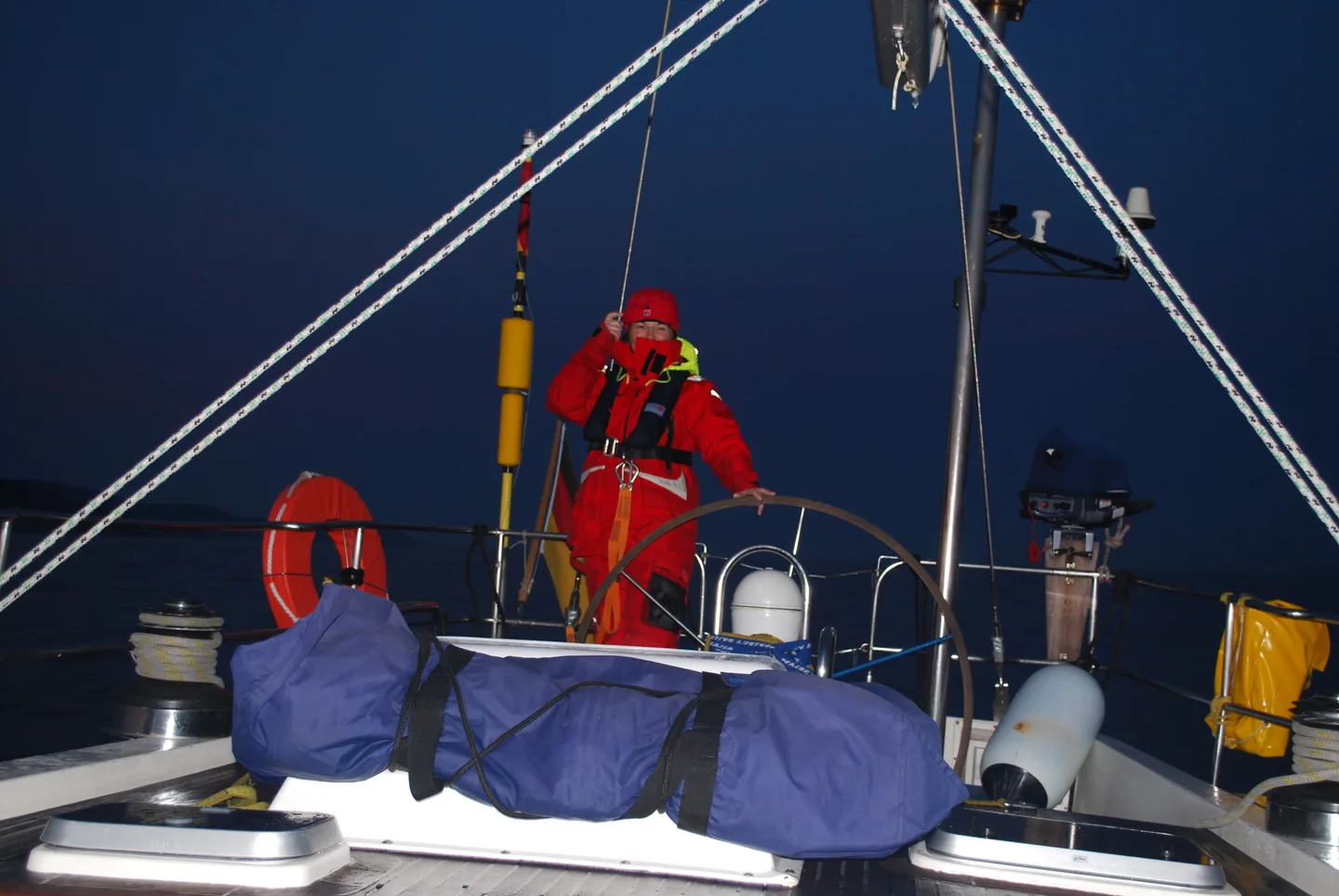
Walk that route in harbour wearing the same foul-weather clothing, lifejacket-harness and tether intended for sea. Check whether a central run fouls a sprayhood or control line, and whether an outboard run places the sailor too close to the rail. Repeat each transfer on both sides; a deck layout that is workable to port may be obstructed to starboard.
Terminations need particular scrutiny. A hook should be able to rotate into the direction of pull instead of lodging against a cleat, eye or jackline end fitting. In the CV30 casualty, MAIB found that a tether hook became caught and was laterally loaded, distorted and released; the lesson is about the geometry of the securing point, not simply the headline strength of the hook.
Read the numbers in context
The current World Sailing rules specify a 2,040 kg breaking strength for jackstays and permit webbing, HMPE rope, or unsleeved and uncoated 1×19 stainless wire with a minimum 5 mm diameter. These are explicit OSR 2026–2027 requirements. They do not prove that an existing deck fitting or the structure beneath it can take the resulting load, so undocumented attachment points warrant assessment by a competent marine professional.
For personal equipment, the OSR calls for an ISO 12401-compliant harness or equivalent. A tether must meet that standard or an equivalent, use self-closing hooks, include a stitching-embedded overload indicator and be no longer than 2 m including hooks. The sailor must also have either a tether no longer than 1 m or an intermediate self-closing hook on the 2 m tether.
These dimensions describe maxima within a rule set, not a promise that every compliant arrangement prevents immersion. The Lion investigation found that line movement and deck geometry can consume the apparent safety margin. Select the shortest usable connection for the immediate task, while preserving the ability to move deliberately and maintain continuous attachment.
Choose materials as part of the installation
Flat webbing can be comfortable underfoot because it is less inclined to roll, but it still needs correct orientation and full-length inspection. Look for cut edges, pulled stitching, glazing, abrasion, chemical contamination and changes that could conceal damage. A wet, dirty or permanently sun-exposed jackline should not receive an automatic pass merely because its label is legible.
HMPE rope and stainless wire introduce different questions about bend radius, terminals, deck contact and elongation. The right choice is the one whose manufacturer instructions match the fittings and routing on the boat. Do not assume that an improvised knot, shackle, splice or cleat hitch preserves the published strength unless the system documentation specifically supports it.
Tension is also a geometric decision. Excessive slack increases travel before the system restrains the sailor, while an over-tensioned line can load fittings and may create a harsh trip hazard. Follow the product maker’s installation limits and assess the loaded, not merely unloaded, position.
Inspect hooks, stitching and anchors
A useful pre-departure check follows the load path from one structural anchor to the other. Examine movement in deck hardware, backing arrangements where accessible, sharp contact points, corrosion, terminal damage and every section of the jackline. Then operate each tether hook with gloved hands and confirm that it closes fully without sticking.
Pay close attention to places where the hook could be cross-loaded or trapped. The CV30 investigation is direct evidence that a hook’s freedom to align matters under real accident loads. Give every completed connection a firm manual tug; this is a functional check that the gate has closed, not a load test.
World Sailing requires replacement of a tether that has been overloaded. If the overload flag is deployed, the tether arrested a fall, or its history is uncertain after a high-load event, retire it in accordance with the manufacturer’s instructions. Unknown age, unreadable markings or damaged stitching should lead to a conservative decision rather than an unsupported estimate of remaining strength.
Make clipping rules explicit
A crew should decide before departure when attachment is compulsory. Night, poor visibility, rising wind or sea state, reduced crew on deck and foredeck work are sensible triggers to consider, but the skipper must tailor the rule to the yacht, voyage and people aboard. The instruction should be short enough to remember and should begin with clipping on while still protected at the companionway.
Two-leg tethers support continuous transfer when used deliberately: connect the next leg, verify it, then release the previous one. At a working station, switch to the short leg when that reduces reach without compromising the task. Loose spare legs must be managed according to the manufacturer’s guidance so that they do not snag, unintentionally load an unsuitable point or interfere with controls.
The harness and lifejacket must be adjusted for the wearer, including crotch or thigh straps where fitted. MAIB’s Lion report warns that the tether attachment point is not the dedicated lifting loop on a lifejacket. Crew should locate the proper recovery point by touch before sailing, because darkness, spray and an inflated bladder make discovery during an emergency far harder.
Drill recovery while the casualty is still tethered
Attachment buys an opportunity; it does not put a person back on deck. MAIB’s CV30 report highlighted the need for effective, regularly drilled recovery procedures for a tethered person overboard. The exercise should cover slowing and controlling the yacht, communicating, reaching the casualty, transferring the load to suitable recovery equipment and dealing with the tether without confusing it with a lifting point.
Run the drill in sheltered conditions with a weighted dummy rather than a person in the water. Test recovery from both sides and identify what changes when the casualty is near the bow or amidships. A readily accessible cutter may form part of the plan for a dangerous towing situation, but the crew must understand when cutting would remove the casualty’s last connection to the yacht.
A complete system leaves few decisions for the worst moment. It offers a continuous path, short connections at work stations, clean hook alignment, known structural anchors, inspected components and a rehearsed recovery method. If the crew cannot explain each of those elements, buying a stronger-looking tether has not closed the underlying gap.
Sources and references
Sources consulted and references retained to verify data and context.
- World Sailing Offshore Special Regulations 2026–2027, Version 1World Sailing · 2025-12-05T00:00:00.000Z
- Man overboard from commercially operated yacht CV30 with loss of 1 lifeUK Marine Accident Investigation Branch · 2019-06-20T00:00:00.000Z
- Report on the investigation of a fatal man overboard from the yacht LionUK Marine Accident Investigation Branch · 2012-02-01T00:00:00.000Z
- Seglerin in Vollzeug.JPGWikimedia Commons · 2015-05-04T00:00:00.000Z