Palermo–Montecarlo 2026 and the Work Behind an Open Course
One mandatory gate across roughly 500 nautical miles turns the race into a live test of routing, crew endurance and verifiable offshore preparation.
Article outline
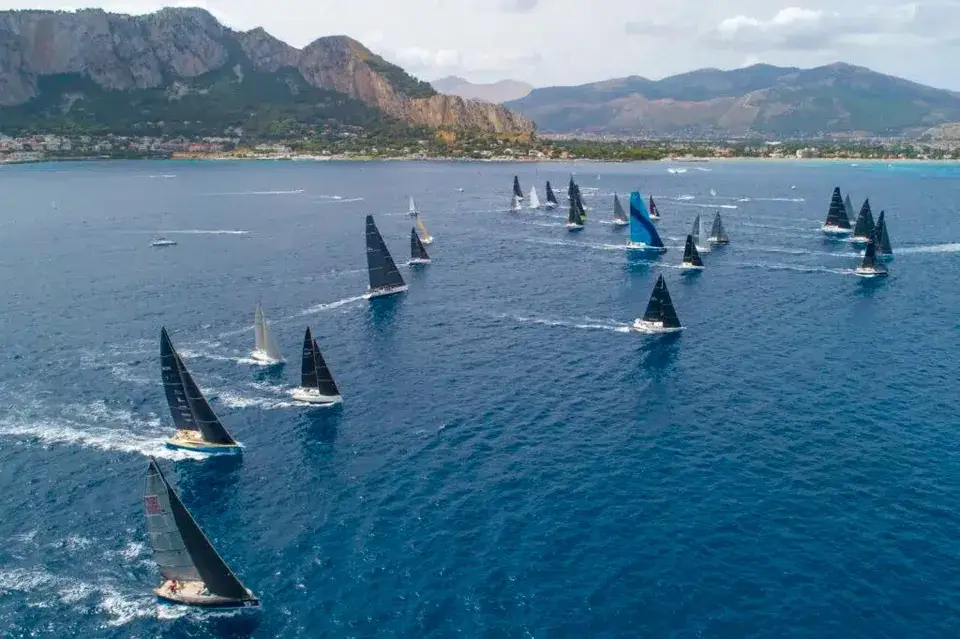
The Palermo–Montecarlo 2026 started from Mondello on 18 August with a feature that makes it more revealing than many tightly defined races: between Sicily and Monaco, the fleet covers roughly 500 nautical miles with only one mandatory gate off Porto Cervo. That apparent freedom moves the work from the buoy to the chart. Every route becomes a negotiation between weather, attainable boat speed and the crew’s ability to keep operating well.
This is not relevant only to maxis and dedicated racers. The Palermo–Montecarlo course is a useful lens for anyone planning a Tyrrhenian passage, assessing an offshore yacht or trying to understand why operational range matters more than a headline speed.
One gate creates a field of choices
The 2026 Notice of Race specifies a start in the Gulf of Mondello, a fly-through gate in front of Porto Cervo and a finish in Monte Carlo. It does not prescribe a narrow lane between them. The shortest distance is therefore not automatically the quickest route, while the fastest route in a forecast may not suit the actual yacht sailing it.
Crews must decide how far to leave the direct line in search of pressure, how to approach Sardinia and which angle to preserve on the northbound leg. The Yacht Club de Monaco identifies the Strait of Bonifacio as a strategic passage where weather analysis and tactical decisions are critical. That confirms the nature of the course; it is not a forecast for the current edition.
For cruising owners, the practical lesson is to route with the boat’s working polars rather than brochure numbers. Sail condition, displacement, autopilot capability and crew strength all belong in the calculation. Buyers comparing production cruisers can examine theDufour Yachts range, but the badge on the hull cannot replace performance data refined through real passages.
Five hundred miles are managed below deck too
Black Jack 100 holds the race record at 38 hours, 53 minutes and 16 seconds, set in 2025, according to the Yacht Club de Monaco. It defines the fast end of the scale; it is not a transferable passage time for a cruiser. At a much lower average speed, the same distance means more sleep cycles, meals, sail changes and opportunities for modest faults to accumulate.
That is where usable design earns its place. Sea berths that still work when pressed, ventilation that can be closed quickly, clear handholds and a chart area readable at night all protect decision quality. TheBeneteauandJeanneaupages offer useful context on how mainstream cruisers distribute volume and functions. Offshore, however, the sharper question is which spaces remain safe when the yacht is heeled and the watch is tired.
Average speed is not produced only during the best hours. It is also preserved by reefing before a manoeuvre becomes expensive, keeping lines organised and avoiding fatigue that takes a capable person out of the watch system. This is Batoo’s analysis, not a claim from the race committee: across 500 miles, an approachable yacht sailed close to its potential may outperform a nominally faster boat that demands too much from its crew.
The Notice of Race exposes the work before departure
The official entry requirements make preparation visible. Eligible yachts must be at least 9 metres long and carry a valid measurement or class certificate for the listed divisions, which include ORC, IRC, Maxi, One Design, Class40, multihull, classic and foiling yachts. At least two crew members must hold a valid World Sailing Offshore Personal Survival Training certificate.
The notice also invokes Category 3 Offshore Special Regulations with a mandatory life raft and personal flotation devices fitted with waterproof strobe lights. It calls for the 2026 OSR checklist, the World Sailing keel and rudder inspection form and adequate third-party liability insurance. These are race requirements, not universal legal obligations for every private cruise.
That distinction should not stop an owner from using the document as an audit prompt. The point is not to copy sporting paperwork, but to test whether the raft, PFDs, steering system and procedures form a coherent safety system. When looking at cruising platforms such as those listed underBavaria, the equipment list deserves to be read alongside machinery access and the ease of inspecting high-load components.
VHF, mobile data and tracking serve different jobs
Palermo–Montecarlo entrants must carry a VHF capable of transmitting on channels 12, 14, 16, 72 and 74. Each yacht also needs at least one internet-connected device with WhatsApp, while an electronic tracker monitors the boats’ positions. These are three separate layers: marine communication, distribution of race information and position tracking.
Treating them as interchangeable is a familiar cruising mistake. Mobile coverage does not replace VHF; a tracker does not provide an emergency conversation; a phone should not be the sole store of contact numbers, forecasts and documents. Useful redundancy comes from separating functions and providing credible power for each.
The same test applies to performance-led designs, including yachts represented on theCantiere del Pardo page. Electronics look persuasive at the dock. At sea, consumption, visibility, waterproofing and the ability to continue after one failure matter more.
An open course rewards disciplined compromise
The time limit expires at 16:00 on 23 August, with the prize-giving scheduled that evening at the Yacht Club de Monaco. Until then, the results will show who best combined wind, boat and rating. The more durable lesson for observers is that an open route makes intelligent compromises unusually easy to see.
Reefing before the manoeuvre becomes costly, accepting extra distance to retain a stable angle, protecting the navigator’s sleep or declining a fragile sail plan are not acts of passive caution. They defend average speed and safety margin at the same time.
The Palermo–Montecarlo 2026 is timely because the event is under way now, but its relevance will outlast the finish. Before any long leg, the strongest route is not the one that displays the highest theoretical number. It is the one that keeps working when the forecast, the boat and the people aboard stop being ideal.
Sources and references
Sources consulted and references retained to verify data and context.
- Palermo–Montecarlo 2026 Notice of RaceCircolo della Vela Sicilia
- 21° Palermo Monte CarloYacht Club de Monaco
Continue reading
Lightning aboard: avoidance, response and checks
October 22, 2026 · 7 min read

Boating in fog: sound signals, radar and Rule 19
October 20, 2026 · 7 min read
Radar reflectors for small craft: choice, mounting and limits
October 18, 2026 · 7 min read