Seacocks and through-hulls: inspection and leaks
A dependable seacock is more than a valve: it is a system of through-hull, fittings and hose. Learn how to map it, test it and respond to water ingress.
In brief
To check seacocks, identify every through-hull, confirm that each valve is accessible, labelled and operable, then inspect fittings, hose and clamps for leakage or deterioration. Keep a suitable plug beside each opening. If seawater enters, slow or stop the boat, locate the source, close the valve when possible, and continuously compare the ingress rate with pumping capacity.
Article outline
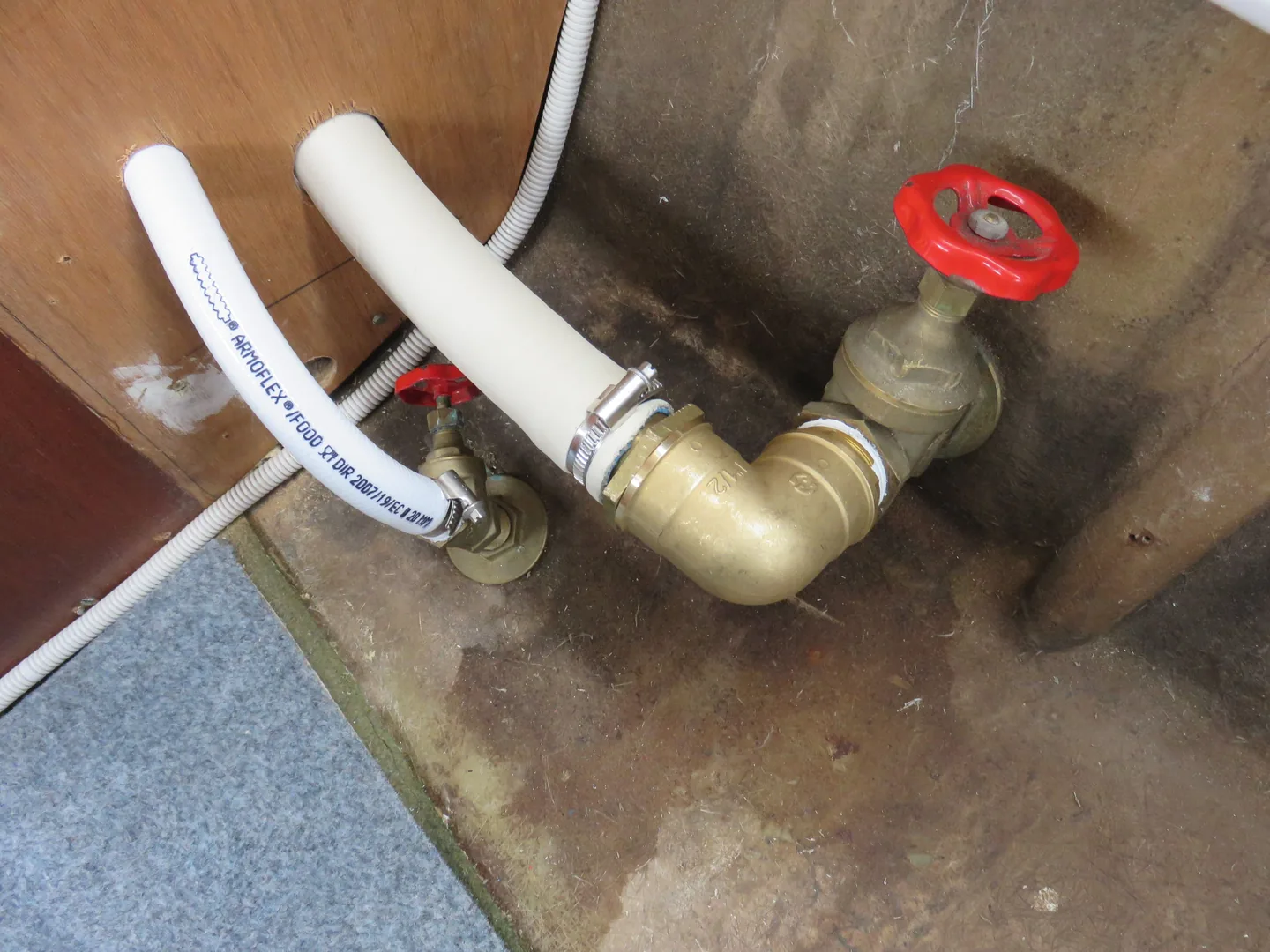
A seacock is easy to forget because it usually works out of sight, yet it connects the inside of a hull to the water outside. A meaningful inspection therefore treats the through-hull, valve, tailpiece, hose, clamps, access and connected service as one system rather than admiring a clean handle.
Start with an inventory that another person can use
Locate every opening below or near the waterline and trace its plumbing to the equipment it serves. Engine raw-water inlets, toilet discharges, sinks, removable instruments and other circuits do not all look alike, so a simple diagram is more useful than memory. Label the service and make the open and closed positions unambiguous.
The UK small-fishing-vessel code says sea inlets and discharges should have an efficient means of closure, with indications of their state and the system served. It also calls for the valve or seacock at the hull connection to be readily accessible in an emergency, using remote operation where direct access is inadequate. Those provisions apply within that code’s scope; for a leisure owner elsewhere, they are sound inspection questions, not proof of legal compliance.
Test access with sole boards, stores and cruising gear in their normal positions. A valve that can be reached only after unloading a locker is not immediately available when water is entering. Ask a crewmember who did not make the diagram to find each closure; the misunderstandings revealed by that exercise are part of the inspection.
Examine the through-hull assembly as a chain
Dry and clean the surrounding area before looking for a leak. Inspect the hull interface, valve body, threaded or bonded connections, tailpiece, hose and support, noting fresh moisture, deposits, distortion, chafe, cracking or movement. None of those observations alone identifies the remedy, but each provides a reason to stop, document the condition and obtain competent advice.
Material compatibility cannot be inferred reliably from colour. For systems under its authority, the MCA code specifies steel, bronze or another equivalent compatible material for valves, piping and fittings attached directly below the load waterline. The important word is compatible: the hull, spacer, valve and connected hardware must be considered together, especially where the exact alloy or polymer is unknown.
Flexible hose should not be used to rescue poor alignment or carry structural load. The same code restricts flexible sections to vibration isolation and requires a sound connection with purpose-designed clips, allowing double clipping where the preferred arrangement is not possible. A second clamp cannot compensate for an undersized tailpiece, the wrong hose diameter or deteriorated hose, so counting clamps is not an inspection method.
Exercise the valve without turning the test into damage
A closure that cannot reach both stops has not demonstrated that it can isolate the opening. Transport Canada’s sample maintenance schedule calls for weekly checks of through-hull fittings and attachments for leaks and includes a check that every fitting can move to the closed position. This is a sample programme rather than a universal interval: manufacturer instructions, construction, operating pattern and local water may justify different timing.
Operate the handle deliberately, without improvised extensions or a violent pull. Record stiffness, incomplete travel, looseness and seepage, then compare the result with the component maker’s instructions. Stop if further force may break the valve or move the fitting in the hull; uncertain support, suspected corrosion and mixed materials need assessment by a qualified professional.
Confirm the final position after the test and restore the configuration required for operation. A successful movement test followed by an engine start with its cooling inlet closed simply exchanges one hazard for another. Batoo’s practical method is a dated log showing valve, position, result and corrective action, with no generic claim that one schedule suits every boat.
Put leak-control equipment beside the opening
A correctly sized plug stored at each through-hull saves a search when visibility, time and footing are poor. MCA guidance MGN 617 calls it good practice to keep a stopper near every skin fitting so it can be wedged into a failed fitting to slow or stop ingress. That plug is temporary damage control, not permission to continue the passage as though the failure had been repaired.
Keep bilge-pump intakes clear and make waterproof lighting, manual dewatering and the damage-control kit reachable. Allocate roles before departure: one person finds the source, another handles the boat, another watches the level or pump discharge, and someone communicates. MCA flooding-drill guidance includes checking the location and amount of ingress, monitoring pumps and alarms, gathering the kit and seeking additional pumping or rescue support when required.
Practise dry unless a controlled procedure specifically provides otherwise. Trace the route, touch the correct valve, match the plug and rehearse a concise report without releasing water or stressing a fitting. An inaccessible hatch, missing tool or mismatched plug is a successful drill finding only after it has been corrected.
Treat seawater inside as a developing situation
Water in a bilge does not by itself prove a seacock failure. MGN 617 advises distinguishing fresh from salt water and using the location and bilge arrangement to guide the search. When salt water is found, it says slowing or stopping will normally be prudent until the source is identified; its checklist also includes shaft or saildrive interfaces, steering gear, keel structure, openings and raw-water cooling.
Put on lifejackets, control the boat and do not send a person alone into an unsafe compartment. Close the identified seacock if the operation is safe, then apply the onboard plug or another planned control. Preserve batteries and electrical pump supplies where that can be done without exposure, because rising water can remove the very capacity being used to fight it.
Measure the trend, not just the presence of water. Compare incoming flow or successive level marks with discharge from pumps and manual methods. MGN 617 describes ingress as manageable when egress is greater, but still directs the skipper to choose the nearest safe haven and maintain updates to a shore contact or rescue service.
Escalate early if the level rises, the source remains unknown, the closure fails or stability changes. The MCA drill guidance pairs flooding response with preparing lifesaving appliances and considering abandonment; that does not mean abandoning automatically, but it prevents preparation from starting too late. A pump running continuously is information, not reassurance.
Finish with a decision for every defect
Classify each finding as serviceable and accessible, observable under a defined interval, or requiring correction before departure. Dated photographs and an updated plan make change easier to recognise, but neither certifies an assembly nor replaces hands-on inspection.
This is Batoo editorial analysis built from the cited official guidance. The rules applicable to the vessel, the equipment manufacturer’s instructions and a competent surveyor or technician take priority over a generic checklist. The real objective is not a momentary absence of drips; it is a system the crew can identify, isolate and manage before a small leak becomes an uncontrolled flood.
Sources and references
Sources consulted and references retained to verify data and context.
- The Code of Practice for the Safety of Small Fishing Vessels of less than 15m Length OverallUK Maritime and Coastguard Agency
- MGN 617 (M): Yacht and powerboat safety at sea—emergency procedures, equipment and actionsUK Maritime and Coastguard Agency
- Sample Maintenance ScheduleTransport Canada
- MGN 570 Amendment No. 1 (F): Fishing vessels—emergency drillsUK Maritime and Coastguard Agency
- Seeventile 1016.JPGWikimedia Commons · 2015-05-26T16:54:55Z
Continue reading
406 MHz EPIRB and PLB: choosing, registering and testing
September 27, 2026 · 7 min read
Navigation lights: inspect and test them aboard
September 26, 2026 · 7 min read
Boat reboarding ladders: test them from the water
September 25, 2026 · 7 min read