Seacocks and through-hulls: inspection and leak response
A practical method for mapping seacocks and through-hulls, checking access, movement, hoses and clamps, and preparing a credible response to water ingress.
In brief
A through-hull is defensible only when its valve is reachable, identified, operable and connected to sound components. Map every hull penetration, test closure without forcing it, inspect supports, hoses and clamps, and keep suitable plugs immediately available. Those habits turn a hidden leak source into an emergency the crew can identify and control.
Article outline
Through-hulls do their work out of sight, yet each one interrupts the hull’s watertight envelope. A meaningful inspection is therefore more than an annual photograph of a valve: the crew must know what it serves, reach it promptly, and assess the complete chain of skin fitting, seacock, adaptor, hose, clamps and supports.
Start with a usable onboard map
Inventory every opening rather than stopping at the engine intake. Toilets, sinks, cooling circuits, drains and removable instruments can follow routes that are not obvious from the cabin; a durable label should connect each valve to its service and show the open and closed positions. TheUK MCA code for small fishing vesselsis not a universal rulebook for private pleasure craft, but it is a useful engineering benchmark: sea connections need effective closure, clear identification and emergency access.
Make a simple plan and give each valve and photograph the same number. Record its purpose, location, closing direction, access route, stated material when known, and inspection date. The result must make sense to someone who did not install the system; knowledge kept only in the owner’s memory is unavailable when the owner is injured or occupied.
Test the physical route in the boat’s normal cruising configuration. Lift the sole, open the locker and put a hand on the handle while stores and equipment are aboard. A tool-fastened panel, tender bag or box of spares can turn apparent access into a delay. MCA flooding guidance tells fishing-vessel crews to know every sea valve’s position and means of closure; pleasure-boat crews can adopt that sound principle without pretending the document creates a universal legal duty.
Inspect the assembly as one load path
A polished valve body does not prove a sound installation. Look for cracking, distortion, weeping, suspicious deposits, corrosion, hardened or swollen hose, distorted clamps and side-loaded fittings; include the backing area and surrounding hull in the view. MCA’s code calls for compatible materials and piping protected from vibration and chafe, which is why the relationship between components matters more than the appearance of one part.
Do not identify a metal from colour alone or scrape an unknown alloy as an improvised test. Record uncertainty about material, thread form or installation history, then have a competent marine professional assess it at haul-out. Applying a cheater bar to a corroded assembly or combining unverified metals can create the failure the inspection was meant to prevent.
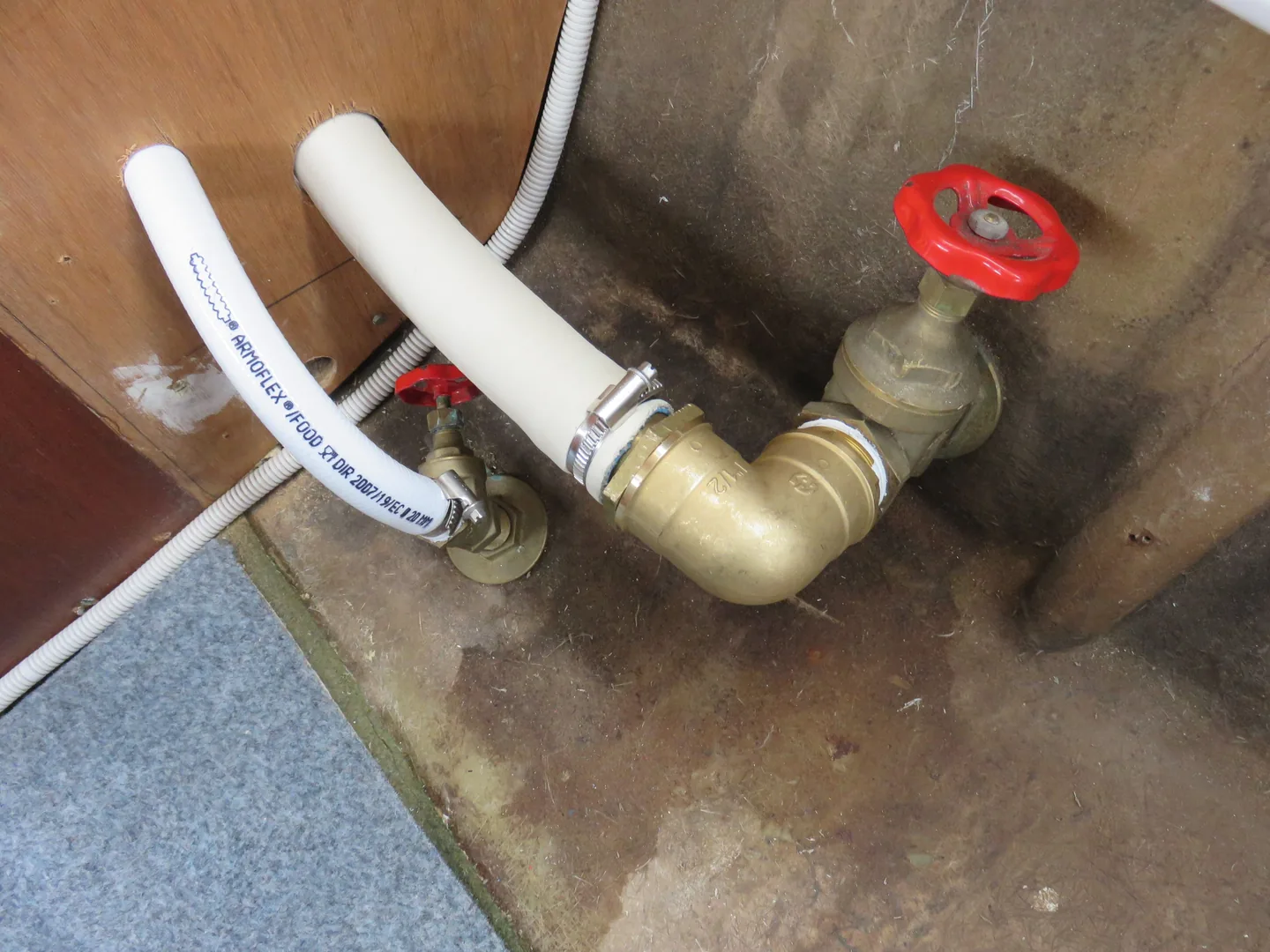
Hose should have a supported route without tight kinks, abrasion or weight hanging from the tail. Clamps need suitable material, correct placement and enough tension to secure rather than cut the hose. BoatUS recommends heavily reinforced hose and two stainless clamps on through-hull connections, while the MCA code prioritises purpose-designed connections and accepts double clipping in specified circumstances; a second clamp is not an improvement if the hose tail has no safe room for it.
Exercise the valve with restraint
The valve should travel through its intended range under control, but an inspection is not a strength test. TheRoyal Yachting Associationincludes operating, greasing and checking seacocks for damage in its seasonal maintenance guidance. The right routine still depends on the valve maker, construction, use and operating environment.
Identify the affected service before moving anything. Closing an engine’s raw-water inlet while it is running is hazardous to the machinery; the system must be returned to the correct configuration before restart and its normal discharge checked as the manufacturer directs. When afloat, watch the assembly during and after movement and have leak-control equipment immediately available.
A useful test answers three separate questions: does the handle move, does its indication correspond to open and closed, and does the valve actually control flow? The first two may be visible, whereas internal sealing and unobstructed flow can demand a system-specific test, often safer ashore. Free movement alone does not establish structural condition or watertight closure.
Stop if ordinary hand effort cannot move the handle. Do not add a pipe or hammer, because the extra leverage is transmitted into the spindle, valve body, mounting and hull. A seized or ambiguous valve is a maintenance finding, not an invitation to force a result while the opening is below the waterline.
Rehearse leak control before an emergency
Keep a suitably sizedconical softwood plugor another compatible leak-stopping device beside each vulnerable penetration, secured so that it remains available but can be used at once. Treat it as containment rather than a permanent repair. Protect people first, raise the alarm, locate the source and close the valve when that can be done safely; pumping and plugging create time, but they do not remove the need for assistance or haul-out when integrity remains uncertain.
Crew should practise finding and pointing to valves from the plan, including in poor light, without staging destructive failures. Assign who keeps control of the boat, who communicates and who approaches the leak. If rising water reaches electrical equipment, blocks access or makes the space unsafe, abandon the search for a neat repair and prioritise distress communication, flotation and escape from immediate danger.
A split hose downstream of an intact valve may be isolated by closing that valve. Failure of the through-hull or valve body is on the sea side of that barrier and may demand plugging or an external patch. This is why inspection must establish where each joint lies; never pull off a hose afloat merely to prove that a valve closes.
After temporary control, continue monitoring the level and the repair. Movement, pressure and access conditions can change, and a plug that appears stable is not evidence that the underlying component has recovered. Log the incident for the technician and preserve photographs only when taking them does not distract from safety.
Turn observations into maintenance decisions
Record a dated result instead of writing “looks fine.” A useful sheet separates access, labelling, travel, leakage, hose and clamp condition, support, and uncertainty about materials. Current MCA flooding guidance proposes at least monthly function testing and greasing for the fishing vessels in its scope; on a pleasure craft that interval is a conservative reference, not a substitute for manufacturer instructions, survey advice or local requirements.
Plan a haul-out when the valve is seized, the through-hull moves, leakage or cracking appears, the backing is degraded, the hose is unsuitable, or threads and materials cannot be identified. Cold-weather lay-up adds another risk:BoatUS Foundationwarns that trapped water and vulnerable hoses or fittings can be damaged by freezing. Drain and recommission only to the design’s correct procedure, so winter protection does not leave an opening unsecured.
Batoo’s analysis leads to a practical standard: a defensible through-hull is one the crew can find, close and describe within an installation whose condition can be verified. Bilge pumps remain essential, but they manage the consequence of ingress. Mapping, access and sound maintenance work on the source, and that division of roles makes the boat more resilient.
Sources and references
Sources consulted and references retained to verify data and context.
- The Code of Practice for the Safety of Small Fishing Vessels of less than 15m Length OverallUK Maritime and Coastguard Agency
- MGN 165 Amendment 2 (F): fishing vessels and the risk of floodingUK Maritime and Coastguard Agency
- Boat maintenance: Spring to-do listRoyal Yachting Association
- The Boat: through-hull fittings and fitting-out checksBoatUS Foundation
- A Best Practices Guide to Fishing Vessel Stability: damage controlTransport Canada / United States Coast Guard