Boat reboarding ladders: test them from the water
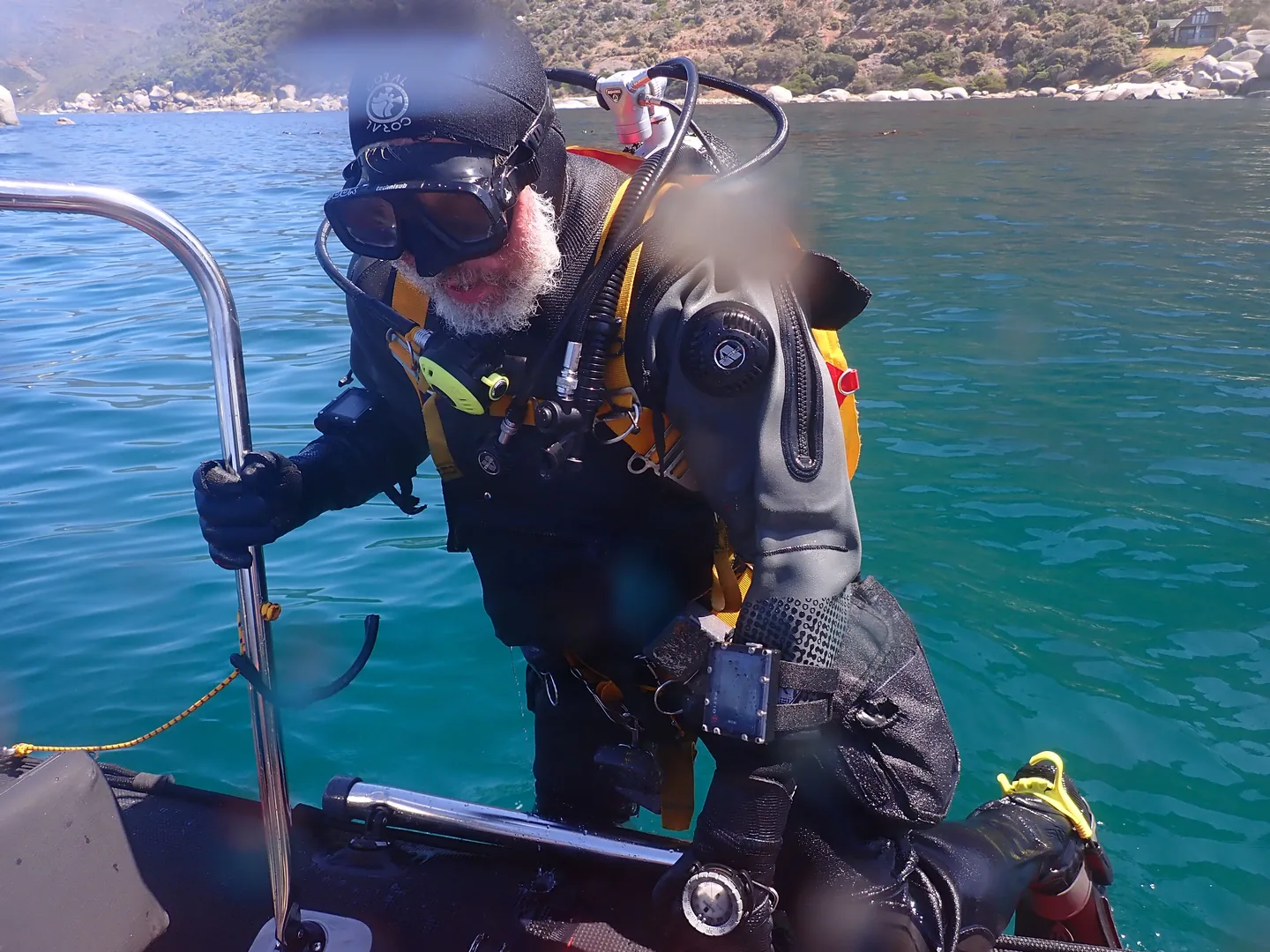
A visible swim ladder does not guarantee recovery. Test water-level deployment, footholds, the final deck transition and the backup for someone unable to climb.
In brief
A reboarding ladder works only if a person in the water can find it, deploy it, reach the first step and complete the move onto deck. Test it in sheltered water with the engine off, supervision and another exit ready. Plan a separate lifting method for anyone unconscious or unable to climb.
Article outline
A swim ladder is easy to regard as deck hardware rather than rescue equipment. That view changes the moment the skipper or only capable crewmember is in the water. The useful test is not whether the ladder looks sound from the dock, but whether someone at water level can find it, deploy it, place a foot securely and complete the transition onto deck.
Recovery has a final vertical barrier
Bringing the boat back alongside a casualty does not complete a person-overboard recovery. Royal Yachting Association guidance separates the approach from the lift: a conscious person may be able to use a line, scramble net, rescue ladder or boarding ladder, while an unconscious person generally needs a lifting arrangement that another crewmember can attach. A boat therefore needs answers for two different physical problems.
The RYA says more than 40% of man-overboard occurrences reported to the UK Marine Accident Investigation Branch from 2015 through 2023 were fatal. That is a statistic about the agency’s reported cases, not a probability for every leisure passage. It is nevertheless a strong reason to test the last metre of recovery with the same seriousness given to the return manoeuvre.
Deployment must be possible from water level
Self-recovery starts with access to the release. A ladder secured by a clip that can only be reached from the cockpit may work when an attentive crew is aboard, but it does not solve a solo skipper’s fall. Even with several people present, an obvious pull, uncomplicated direction of travel and a ladder that drops clear of the hull reduce steps during a high-pressure event.
Depth matters because the swimmer must first raise body weight onto the lowest support. In Canada, the applicable pleasure-craft guidance states that a reboarding device is required when a person must climb more than 0.5 m vertically from the water. This is a Canadian regulatory threshold, not a worldwide design rule, yet it usefully illustrates why a step barely below the surface can leave a tired person with an unrealistic movement.
The route cannot end at the top rung. Batoo’s practical assessment is to trace both hands and both feet through the full movement, including the transfer across the platform or coaming. A handhold that ends early, a tender blocking the platform or a large gap to the cockpit can turn an apparently adequate ladder into an incomplete system. This assessment does not replace the builder’s instructions or a competent inspection of structural fittings.
The convenient stern may also contain the propeller
The lowest boarding point is often close to propulsion. Transport Canada explicitly warns boaters not to use the engine or its mounting brackets for reboarding because serious injury can result. RYA guidance says the casualty must be protected from a spinning propeller and discusses neutral or shutdown according to the vessel and conditions; the correct control sequence must therefore be defined for the particular installation.
A crew brief should identify who watches the person, who controls the boat and who prepares recovery equipment. The position of a control lever alone should not be treated as proof that every propulsive hazard has disappeared. Owners should follow the propulsion manufacturer’s procedures and account for their own boat’s layout, including multiple engines, saildrives or exposed gear.
There is no universal best side. A sailing yacht may offer a clear side deck but substantial freeboard, while a motorboat may offer a low platform beside the machinery. Wind, waves and damage may also remove the preferred station. Batoo therefore recommends naming a primary recovery location and a workable alternative during the pre-departure briefing.
A sheltered-water test reveals usability
The first trial belongs in sheltered water with the engine shut down, supervision in place and another safe exit available. A willing participant wearing the normal flotation equipment approaches from the water and attempts to locate and release the device. There is no benefit in manufacturing fatigue or rough conditions: the initial objective is to observe reach, movement and stability without creating a rescue.
Watch the sequence rather than merely recording success. Can the person establish a handhold before lifting a knee? Does the bottom step swing under the hull, move away from the foot or trap fingers against the transom? Can the climber move from the last step to the cockpit without pulling on an unsuitable rail? Each observation should lead to a defined correction, with professional advice where attachments or hull structure are involved.
A second controlled attempt with the usual lifejacket may expose interference around the chest or shoulders. An unconscious-casualty exercise should not be improvised in the same way. The RYA describes that recovery as much more demanding and notes that a crewmember may need to connect a lifting device while leaning or being lowered toward the casualty, which introduces danger to the rescuer.
A ladder and a lifting system answer different failures
A ladder mainly serves someone who is conscious, mobile and able to follow instructions. A halyard, tackle, davit or dedicated lift may handle a person who cannot climb, but only when it can be rigged and attached promptly by the people actually aboard. Equipment stored beneath other gear or known only to the skipper is not a complete method.
For an unconscious casualty, the RYA advises keeping the person horizontal during lifting where possible to limit potential medical complications, while emphasizing that removal from the drowning risk comes first. That is a planning principle, not a reason to delay recovery. Training from a competent provider is the appropriate place to practise the connection, lift and casualty care.
The MAIB investigation into the fatal Saint Peter accident shows how separate safety layers can fail to complete the chain. The skipper’s automatically inflating personal flotation device kept him afloat with his airway clear for about nine hours, but no self-recovery arrangement had been rigged and he could not send a distress message from the water. The agency highlighted both reboarding measures and a personal distress beacon as ways to improve survival prospects.
Record a result, not an assumption
A compact vessel note can make the check repeatable. Record whether the ladder can be released from the water, which supports are genuinely submerged, where the upper handholds are and what changes when normal flotation gear is worn. Add the location of the assisted-lift equipment and identify who makes the propulsion safe.
Transport Canada accepts transom ladders and swim-platform ladders within its guidance, and it also describes a dedicated rope as a possible reboarding device under its rules. The same rope is not to be used for another purpose. Boats operating elsewhere must check flag-state and local requirements rather than importing the Canadian rule as if it applied globally.
The outcome should fit one of three categories: demonstrated access, a modification to be assessed, or a different recovery method that must be rigged before departure. If the release cannot be reached, the first foothold cannot be gained, or the route crosses a propeller hazard, the system has not passed. A visible ladder is reassuring; a controlled, repeatable path from water to deck is evidence.
Sources and references
Sources consulted and references retained to verify data and context.
- Safe Boating Guide – Safety Tips and Requirements for Pleasure CraftsTransport Canada
- Man Overboard | Cold Water Shock SafetyRoyal Yachting Association
- Safety lessons: consider emergency measures for reboarding your fishing vesselUK Marine Accident Investigation Branch · 2022-05-12
- Diver boarding using dive boat ladder P3070567.jpgWikimedia Commons · 2020-03-07
Continue reading
406 MHz EPIRB and PLB: choosing, registering and testing
September 27, 2026 · 7 min read
Navigation lights: inspect and test them aboard
September 26, 2026 · 7 min read
Bilge pumps: testing, inspection and flooding response
September 24, 2026 · 6 min read