VHF DSC: MMSI, position and distress calling
A DSC VHF is only as useful as its MMSI, live GNSS position and tested installation. This guide checks the full alert chain and prepares the crew to use it.
In brief
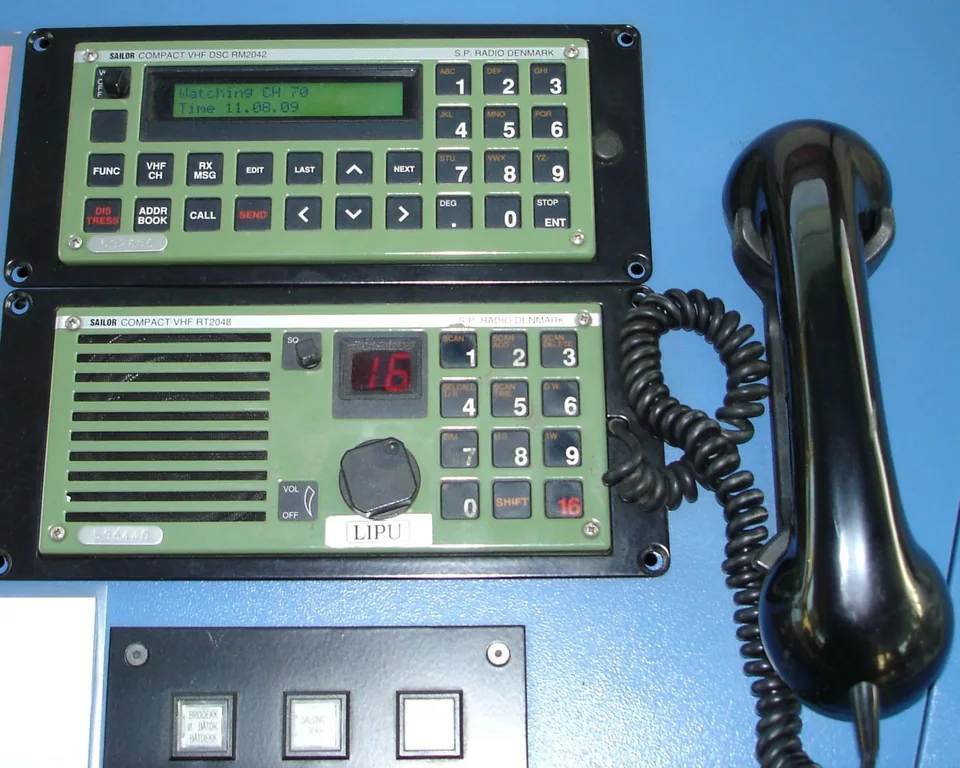
To make a fixed DSC VHF operational, register the correct MMSI, confirm that current GNSS position and time appear on the display, inspect the antenna and power supply, and use only a test method authorised in your area. In distress, send the DSC alert, move to the indicated voice channel, then give a Mayday with identity, position, problem and assistance required.
Article outline
A protected red button does not, by itself, turn a radio into a rescue system. A DSC VHF works as a chain in which vessel identity, position data, antenna, electrical supply and operator all have to be ready at once. One missing link can turn a data-rich alert into an incomplete request for help.
Commissioning should therefore examine the whole installation, not merely confirm that the display lights up before departure. The approach below is intended for prudent leisure-craft operation; station licences, operator certificates and approved test procedures remain matters for the radio administration and coast service in the country where the set is used.
What the DSC alert actually carries
Digital selective calling uses VHF Channel 70 for digital distress, urgency, safety and calling signals. Depending on the call and equipment, the alert can contain the MMSI, position, time of the latest position, nature of distress and the channel or mode for follow-up communication. Channel 70 is not a voice channel: the detailed conversation follows on the appropriate radiotelephony channel, normally Channel 16 for a distress message.
Class D is the familiar small-craft implementation. Its defined functions include distress, all-ships and individual calls, distress information, reception of acknowledgements and relays, and test calls. That capability label does not prove the installation is feeding the radio a valid identity or a current position.
DSC is best understood as the dial and bell, not the conversation itself. It can attract the attention of compatible sets within radio range without requiring somebody to hear a spoken call at the right instant. Voice then lets a rescue authority and nearby vessels clarify the casualty and coordinate action, which is why the microphone remains as important as the digital control.
Give the radio the right nine-digit identity
A Maritime Mobile Service Identity is a nine-digit number used by DSC, AIS and certain other maritime equipment to identify a vessel or coast station. Obtain it through the authority or authorised issuing route that applies to the vessel and its operating area. Never invent one or copy the number shown on a previous radio, another boat or a sales listing.
Check the assigned number against the paperwork before entering it. Many radios restrict the operator from changing an MMSI once it has been programmed, so correcting a mistake may require an authorised service procedure. Where both AIS and DSC are fitted, the identities should describe the same vessel unless the responsible administration has explicitly provided otherwise.
Registration data require maintenance too. Rescue watchstanders can use the record to understand the vessel, its owner contacts and declared equipment, and accurate information helps them assess whether an alert is genuine or accidental. When a boat is sold, bought or moved into a different licensing situation, contact the MMSI issuer about release, transfer or a new assignment rather than editing labels at the helm.
This is an administrative task with immediate operational value. Add an annual record review to the safety schedule and revisit it after changes of ownership, vessel name, emergency contact or radio installation. A correctly displayed number is not enough if the database behind it still describes somebody else’s boat.
Prove that position reaches the VHF
A distress alert with a recent position gives responders a useful starting point. The coordinates may come from a GNSS receiver built into the radio or from an external navigation device over the interface specified by both manufacturers. A chartplotter showing a fix does not establish that the VHF is receiving it.
Read latitude, longitude and UTC time on the radio itself. Confirm that the information is plausible, current and refreshed after the vessel moves. Repeat this check after electrical work, a software change, plotter replacement or any alteration to the data network.
The US Coast Guard notes that many DSC radios and GPS receivers use NMEA 0183, but the cable and connector form is not standardised. Newer installations may use other supported links. Follow both manuals for port selection, data sentences, speed and wiring; matching wire colours by guesswork is not a commissioning method.
Learn how the set reports lost or stale position data. Some radios provide an age warning or alarm, while the manual may describe a temporary manual-entry route. Batoo’s practical recommendation is to write “position and UTC visible on the VHF” on the departure checklist, rather than the less useful “GPS on”.
Treat antenna and power as safety equipment
Digital formatting cannot overcome a failed coaxial connection or a supply voltage that collapses while transmitting. Inspect the aerial, mount, coax route, connectors and exposed deck penetrations for movement, water entry, abrasion and tight bends. Reception of nearby traffic alone does not demonstrate effective transmitted power.
A technician with suitable instruments can assess output, standing-wave behaviour and the antenna system more meaningfully than a casual radio check. Between professional inspections, investigate any sudden reduction in range, intermittent reception, hot connector or transmission-related reset. Do not keep transmitting repeatedly through a suspected antenna fault.
Test with the boat’s normal battery arrangement rather than only while a shore charger is supporting the voltage. Identify the breaker, fuse and source battery, and make sure the crew knows which circuit supplies the fixed set. The value of the higher aerial on a fixed VHF disappears if an electrical incident leaves it without power.
Inspect the user end as well. A damaged push-to-talk switch, blocked microphone or muted remote speaker can defeat the voice follow-up after a successful digital alert. Keep a waterproof prompt card at the set with vessel name, call sign, MMSI and the order of the spoken Mayday; do not store changing position coordinates on a static card.
Test the call path, never the distress button
A live distress alert must never be used as a radio test. Use the set’s designated DSC test function where a coast network supports and authorises it, or an agreed individual call to another compatible station where local rules permit. Consult the national coast service and the radio manual because test facilities and identities differ between countries.
In the United States, Coast Guard Rescue 21 stations provide an automated response to a test call sent to group identity 003669999. That is a regional service, not a worldwide test number. An acknowledgement shows that the particular digital exchange worked at that time and place; it does not certify future coverage, voice quality, battery endurance or every part of the aerial system.
A sensible end-to-end exercise includes receiving normally, making an authorised DSC test or individual call, observing the acknowledgement, changing to an agreed working channel and checking brief two-way speech. Record the date, area, result and any fault. If the call is not acknowledged, review the display, MMSI, data, power and aerial before escalating to technical diagnosis.
Crew training can be conducted with the radio off or in a manufacturer-provided simulation mode. Each watchkeeper should find the position screen, explain what lifting the red cover means and locate the cancellation instructions. Practice must never create a signal that another vessel or rescue centre could mistake for real distress.
Continue the red-button alert by voice
For grave and imminent danger, uncover the control, select the nature of distress if time permits, and hold the button for the period specified by the manufacturer. Leave the set on and listen for acknowledgement. The radio should then lead the operator toward the follow-up voice channel, normally Channel 16, but the exact display sequence must be learned from that model’s manual beforehand.
The digital burst is not a replacement for the spoken Mayday. Say “Mayday” three times, give the vessel name and identification, position, nature of distress, assistance required, number of people aboard and any useful description. Speak slowly, release push-to-talk to listen, and follow the directions of the station coordinating the response.
If a distress alert is sent accidentally, simply switching off is the wrong response. Stop further transmissions as the manual directs and promptly broadcast the cancellation to the appropriate coast station, giving the vessel identity, MMSI, position and reason. Post the locally correct cancellation steps beside the radio because details can vary by administration and equipment.
The final link is human rather than electronic. Anyone who might be left at the helm should be able to read the radio’s position, operate the protected control in a real emergency and describe what has happened. DSC cannot promise coverage or an automatic rescue, but a correctly commissioned system can deliver the crucial first facts quickly while preserving the two-way voice channel needed to finish the job.
Sources and references
Sources consulted and references retained to verify data and context.
- Digital Selective CallingU.S. Coast Guard Navigation Center
- Maritime Mobile Service IdentityU.S. Coast Guard Navigation Center
- DSC TestingU.S. Coast Guard Navigation Center
- GMDSS: The Benefits of Digital Selective CallingUK Maritime and Coastguard Agency · 2017-08-01
- Digital Selective Calling ClassesU.S. Coast Guard Navigation Center