Self-tacking jib or genoa: choose for your crew
The headsail changes both cockpit workload and how the crew takes part. A documented comparison uses the Bavaria C42 and a three-crew decision matrix without promising performance.
In brief
A self-tacking jib is the more coherent choice when a short-handed crew tacks often and wants less sheet work. A conventional genoa makes more sense when the crew actively wants to trim and the boat is equipped for it. The sail name is not enough: inventory, tracks, winches, leads and documents must identify what is actually installed.
Article outline
On the same yacht, a tack can feel like a nearly solo action at the helm or a compact piece of teamwork. The headsail choice decides who acts, how often and with how much coordination, so it deserves more thought than a tick in an options list.
This is a cruising comparison, not a performance ranking. The Bavaria C42 is used as a documentary example because its published material describes alternative arrangements; no sea trial or universal verdict is implied.
The choice becomes visible during a tack
A self-tacking jib removes the specific job of swapping loaded and lazy sheets during the turn. In its system manual, Seldén describes a sheet led to a car that travels to leeward as the yacht changes tack, and states that the purpose-designed sail cannot overlap the mast. The helm still has to steer a controlled course and the crew still has to manage the rest of the boat. “Self-tacking” describes one part of the sail-handling system, not an autonomous yacht.
A conventional headsail with two sheets creates a different cockpit routine. The old working sheet is released, the new one is gathered and the sail is trimmed on the new side. A US Naval Academy training sequence for its Navy 44 assigns separate helm and sheet roles. That procedure is not a prescription for every cruising yacht, but it makes the organisational point plainly: somebody must be ready to handle the sail.
This leads to a useful first test. When two people sail and one is also monitoring traffic, route and the wider manoeuvre, removing the sheet exchange can reduce a repetitive demand. When several people actively want to learn trim and timing, the conventional routine may be part of the pleasure rather than an unwanted chore.
The C42 proves that a model name is not a configuration
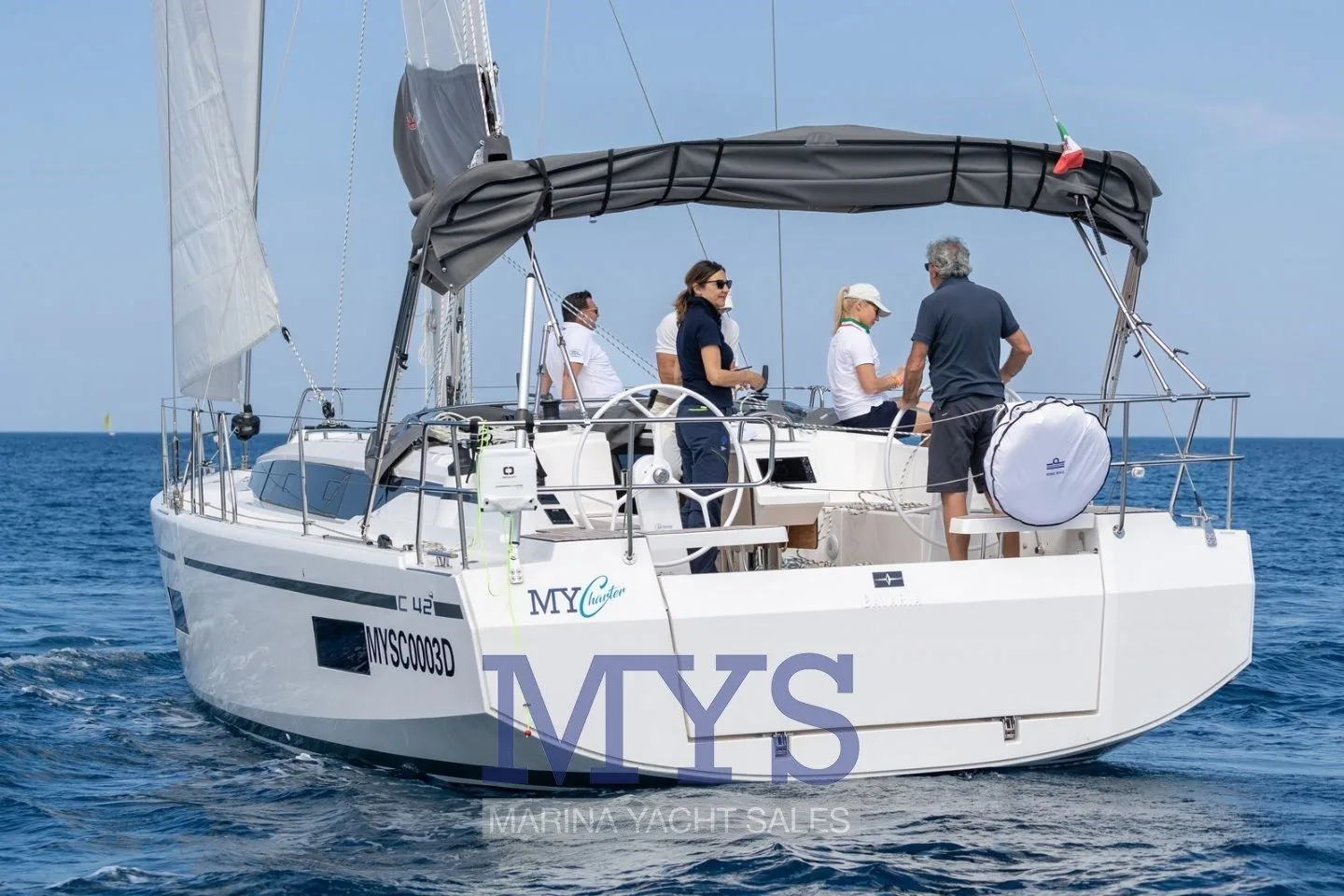
Bavaria’s published C42 material does not let a buyer infer every individual boat’s headsail package. The current Bavaria data page calls the self-tacking jib standard and lists jib and genoa separately in its technical table. Those are current range statements. A particular yacht still needs to be checked against its delivered documents, sail inventory and visible deck gear.
The designer’s account makes the possible divergence clearer. Cossutti Yacht Design describes a self-tacking jib and/or a conventional jib on longitudinal tracks, optional additional winches for a 105% genoa, and an aft-winch arrangement that can place jib and mainsail controls near the helm on opposite sides. These are attributed design and option statements, not evidence that every C42 carries them.
The published Batoo Bavaria C42 model guide remains the place for model identity, variants and used-boat context. In this article the boat serves a narrower purpose: showing why the word “genoa” may imply tracks, winches and crew work that a short sail list does not reveal.
Three crews expose three different priorities
The matrix is original Batoo editorial analysis. It connects the documented two-sheet and traveller arrangements with three explicitly illustrative situations; it does not measure speed, pointing angle, safety or the performance of any particular yacht.
| Illustrative situation | Real priority | Self-tacking jib | Conventional genoa |
|---|---|---|---|
| Two people, frequent short tacks | Reduce repeated cockpit tasks | Coherent when the installed system is documented and operates correctly | One person must release, gather and trim the sheets |
| Crew eager to participate | Create meaningful roles and learn coordination | Less headsail work during the tack | A clear sheet-handling role, where skill and deck layout support it |
| Buyer inspecting a used yacht | Establish what is actually included | Identify track, car, sheet, leads and a compatible sail | Identify two sheets, winches, tracks or lead points and the inventory |
| Crew changes from trip to trip | Keep the routine predictable | May shorten the briefing but does not remove other duties | Works when roles are reassigned and understood each time |
The first row does not declare an automatic winner. A couple sailing long offshore legs might tack rarely and give the distinction modest weight; a coastal crew making repeated course changes may value it highly. Count the manoeuvres in the intended programme and the available hands before comparing sail labels.
Participation also needs an honest definition. Giving a newcomer a sheet is useful only when timing, communication, position and limits are explained. If nobody aboard wants that task, extra sail area on paper can become an awkward job that is postponed or performed poorly; this article makes no claim about the resulting speed.
Read the hardware before trusting the inventory
An installed configuration should be reconstructed from matching evidence. Ask for a signed inventory, original invoice or build specification, sail labels, recent photographs and the deck hardware itself. On a self-tacking arrangement, identify the purpose-made sail, track, car, end stops, sheet and lead path. On the conventional arrangement, identify both sheets, the working winches, tracks or lead points and how each line reaches the cockpit.
Seldén’s manual says that the sail must be designed for the system and highlights sheet routing, deck construction and obstructions as compatibility issues. That is why this comparison is not a retrofit tutorial. A sailmaker should assess the sail and sheeting geometry, while any question involving deck structure and loads belongs with professionals familiar with the specific yacht and installation.
Condition matters as much as the diagram. A stiff car, damaged end stops, poor leads or a sail that differs from the paperwork can change both usability and cost. With a conventional genoa, winch number, position and condition influence who can do the work and from where. Finding a genoa in a locker does not prove that the complete handling system is ready.
Finish with a crew brief, not a league table
Before viewing yachts, write one operational sentence: “we usually sail as two, make frequent short tacks and want the helm to keep the manoeuvre manageable,” or “we normally sail as four, two people want active sheet roles and we need a deck layout that supports them.” This is more discriminating than asking for “more sail” or “maximum simplicity.”
Next, request a named sail inventory and close photographs of tracks, cars, winches and leads. The Batoo used-boats catalogue can help compare how individual yachts describe that equipment, but two listings for the same model should never be presumed identical. Take the resulting file to a sailmaker and reconcile it with the crew brief. The useful choice is where desired participation meets the yacht that actually exists.
Sources and references
Sources consulted and references retained to verify data and context.
- BAVARIA C42 — Data and OptionsBAVARIA YACHTS
- Bavaria C42 — the Cossutti Yacht Design projectCossutti-Ganz Yacht Design
- Self-tacking system 22 — manual 597-278-ESeldén Mast AB
- Navy 44 Sailing Guide — TackingUnited States Naval Academy